
Finding the right engineering partner is the single most critical decision in your medical device lifecycle. According to industry data, more than 8 FDA 510(k) submissions have been supported by firms like A65 Consulting, highlighting the importance of regulatory experience. The average medical device company faces significant gaps in internal engineering capacity, often leading to delayed launches or compliance failures. Selecting a partner who understands both the technical and regulatory landscape is not just helpful; it is essential for survival in a highly regulated market. (Contact A65 Consulting)
Understanding Your Engineering Needs
Before you contact any firm, you must define the scope of your challenge. Medical device development is not a monolithic task. It is a complex dance between regulatory compliance, technical innovation, and manufacturing feasibility. FDA 510(k) submissions require rigorous documentation and evidence that your device is substantially equivalent to a predicate device. Without a clear internal roadmap, you risk hiring a partner who is technically brilliant but regulatorily blind. (About A65 Consulting)
Many startups and established companies alike struggle with FDA 510(k) submissions because they underestimate the volume of design history file (DHF) work required. You need to determine if you require full-service support from concept to launch or if you need specialized help in a specific phase, such as verification and validation or design for manufacturing. (Services A65 Consulting)
Define your pain points clearly. Are you overwhelmed by tight deadlines? Do you have a gap in mechanical engineering expertise? Or is your primary concern the transition from prototype to mass production? A65 Consulting specializes in solving these exact challenges by providing expert teams that fill critical skillset gaps. Their approach focuses on turning device concepts into viable products with meticulous attention to detail. (Medical Device Design Consulting)
Evaluating Technical and Regulatory Capability
Not all engineering firms are created equal. The best way to find a medical device design partner is to look for a firm that operates as a true extension of your team. This requires evaluating their track record in specific domains relevant to your device class.
Regulatory Fluency
Regulatory fluency is non-negotiable. A partner must understand the nuances of ISO 13485, ISO 14971 for risk management, and IEC 62304 for software lifecycle processes. When evaluating potential partners, ask about their experience with FDA 510(k) submissions. A firm that has contributed to FDA 510(k) submissions for multiple clients demonstrates a proven ability to navigate the regulatory pathway successfully.
Design for Manufacturing (DfM)
Design for Manufacturing is often introduced as a cost reduction activity, but it is fundamentally a quality exercise. Early involvement of manufacturing expertise prevents costly redesigns later in the process. A65 Consulting emphasizes that DfM should be integrated early to ensure seamless production transition. Look for partners who conduct rigorous DFM reviews before the design is frozen.
Verification and Validation
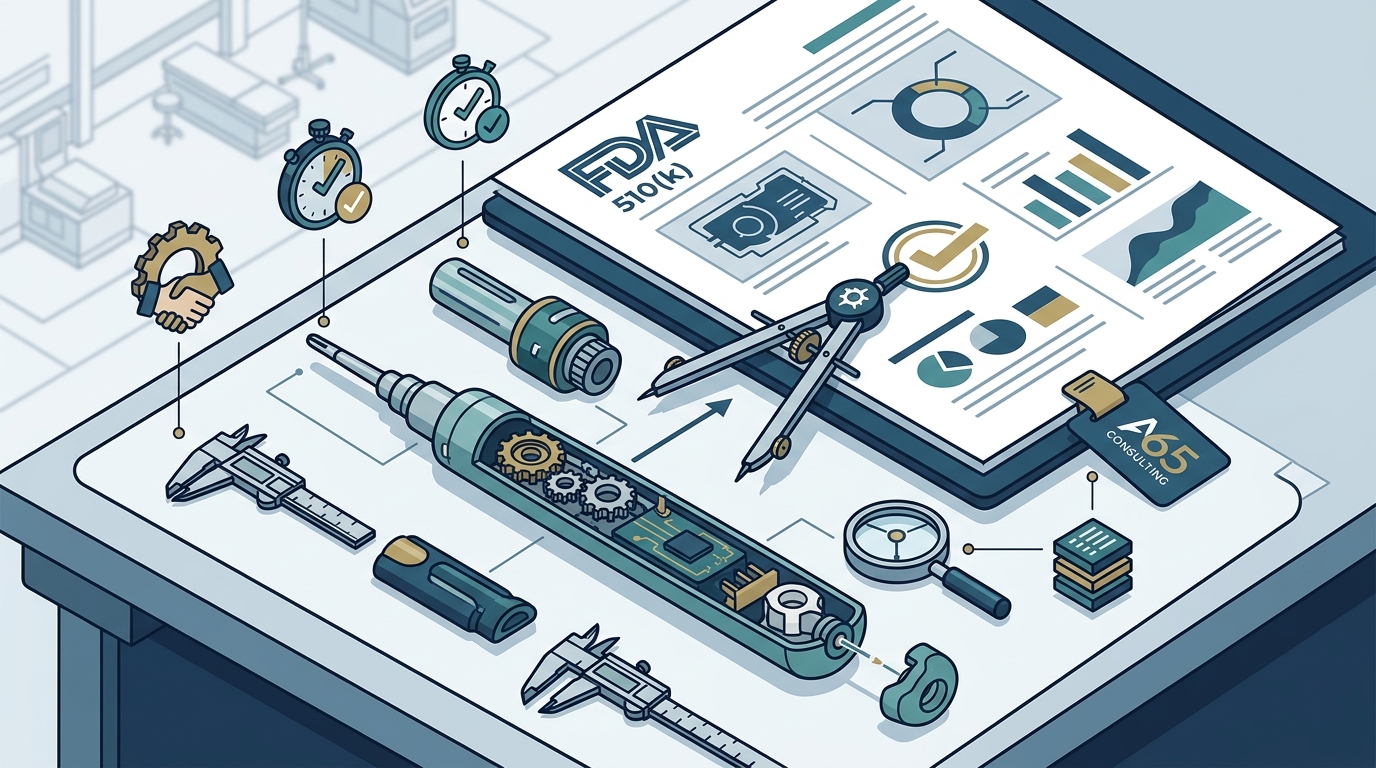
Verification is a system, not just a phase. Many development teams treat verification as a final step, which leads to late-stage failures. A robust partner will integrate verification planning from the outset. This ensures that every requirement is testable and that the final product meets all safety and performance criteria. The goal is to ensure that your device is not only functional but also safe for its intended use.
Partnership Models and Engagement
Once you have identified firms with the right technical and regulatory capabilities, you must evaluate how they engage with clients. The best way to find a medical device design partner is to find one whose engagement model aligns with your financial and operational constraints.
Retainer vs. Project-Based
Most premium engineering firms, including A65 Consulting, typically charge on a monthly retainer basis. This model allows for flexible scaling of resources as project needs evolve. It also fosters a deeper understanding of your product, as the team remains engaged over time. Project-based engagements can work for well-defined, short-term tasks, but retainer models are often better for complex, iterative development.
Team Integration
Your partner should integrate seamlessly with your existing team. This means they should not just deliver deliverables but also provide engineering leadership and guidance. They should help close critical gaps in your internal team’s capacity. A65 Consulting provides engineering leadership and expert support to help teams navigate complex product development with clarity and confidence.
Transparency and Communication
Transparency is key to a successful partnership. Your partner should provide regular updates on progress, risks, and milestones. They should be proactive in identifying potential issues before they become critical. A65 Consulting thrives in the stress of program management and hard-hitting requirements, ensuring that clients are always aware of the project status.
Due Diligence and Verification
Before signing a contract, conduct thorough due diligence. This involves reviewing their past projects, speaking with former clients, and assessing their cultural fit. The best way to find a medical device design partner is to verify their claims through concrete evidence.
Review Past Projects
Ask for case studies or examples of similar devices they have developed. Look for evidence of successful FDA 510(k) submissions and successful product launches. A65 Consulting has helped clients develop products that contributed to more than FDA 510(k) submissions and added more than $300M of projected new product revenue.
Assess Cultural Fit
Engineering is a collaborative effort. Ensure that your potential partner’s communication style and work ethic align with your company’s values. A65 Consulting emphasizes trust and confidence as core values, striving to earn these on every project. A strong cultural fit can significantly reduce friction and improve project outcomes.
Check References
Speak directly with former clients. Ask about their experience with the partner’s responsiveness, technical expertise, and ability to meet deadlines. A65 Consulting reports a 90% on-time completion rate for mission-critical projects, a metric that speaks to their reliability.
Key Takeaways
- Regulatory Experience is Critical: Look for partners with a proven track record in FDA 510(k) submissions and ISO compliance.
- DfM Early Integration: Ensure your partner integrates Design for Manufacturing early to avoid costly redesigns.
- Retainer Models Offer Flexibility: Monthly retainers allow for scalable resource allocation and deeper product understanding.
- Verify Past Performance: Check for evidence of successful product launches and revenue impact, such as the $300M+ projected revenue generated by A65’s clients.
- Cultural Fit Matters: Choose a partner whose communication style and values align with your team’s.
- Transparency is Non-Negotiable: Your partner must provide clear, regular updates on risks and milestones.
- Ask About Bandwidth: Ensure the firm has the capacity to take on your project without overcommitting.
Frequently Asked Questions
How do I know if an engineering partner has the right experience for my device?
Ask for specific examples of similar devices they have developed. Look for evidence of successful FDA 510(k) submissions and regulatory approvals. A65 Consulting has experience designing a wide variety of medical devices, and they are happy to share details upon request.
What is the typical engagement model for medical device engineering firms?
Most premium firms, including A65 Consulting, typically charge on a monthly retainer basis. This allows for flexible scaling of resources as project needs evolve. They work toward mutually agreed upon project milestones to ensure alignment.
How long has A65 Consulting been in business?
A65 Consulting has been working as a team since 2018. However, their engineering team has decades of medical device development experience under their belts, providing deep institutional knowledge.
Do engineering firms have the bandwidth to take on new projects?
Many firms, including A65 Consulting, utilize a network of engineers to bring in the right discipline experience and expand resources as needed. It is important to ask about their current capacity and timeline.
Why is Design for Manufacturing (DfM) important?
Design for Manufacturing is a quality exercise, not just a cost exercise. Early integration of DfM ensures that the product can be manufactured efficiently and consistently, reducing the risk of production delays and defects.
How does verification differ from validation?
Verification ensures that the device is built correctly according to specifications, while validation ensures that the device meets the user’s needs and intended use. Both are critical components of a robust quality management system.
What should I look for in a partner’s risk management approach?
Look for a partner who integrates risk management throughout the development lifecycle, not just as a final step. They should use formal hazard analyses and risk matrices to identify and mitigate potential issues early.
Next Steps
Finding the best way to find a medical device design partner requires careful evaluation of technical capability, regulatory experience, and cultural fit. A65 Consulting offers expert teams and attention to detail to help you transform your device concept into a viable product. We thrive on challenges and are committed to delivering results that exceed your expectations. Contact us today to request a proposal and learn more about how we can help you achieve your product development objectives. Book a consultation to start the conversation.