
The global medical device market is projected to reach $800 billion by 2030, driven by an aging population and rapid technological integration. For innovators, the complexity of navigating this landscape is immense. Bridging the gap between a raw concept and a commercially viable, FDA-cleared product requires more than just engineering talent. It demands a holistic approach that integrates regulatory strategy, human factors, and manufacturing readiness from day one. This guide explores how to identify firms that offer true end-to-end capabilities. (Contact A65 Consulting)
What Is End-to-End Medical Device Design?
End-to-end medical device design refers to a comprehensive service model where a single engineering partner manages the entire product lifecycle. This approach eliminates the friction of handing off projects between disparate vendors. Instead, the firm oversees everything from initial market research and conceptual design to regulatory submission and manufacturing transfer. Medical device design is the systematic process of translating clinical needs into functional, safe, and compliant hardware and software solutions. By consolidating these responsibilities, companies reduce timeline risks and ensure that design decisions made in the early stages align with manufacturing and regulatory realities.
According to recent industry analyses, 70% of medical device failures stem from poor communication between design and manufacturing teams. End-to-end firms mitigate this by integrating Design for Manufacturing (DFM) principles early in the process. This ensures that the device is not only innovative but also producible at scale. The goal is to transform a concept into a viable product that meets clinical requirements while adhering to strict regulatory frameworks.
The Core Phases of the Development Lifecycle
Understanding the phases of development is crucial for evaluating potential partners. A true end-to-end firm must demonstrate proficiency in each stage.
Concept and Feasibility
The journey begins with defining the problem and validating the solution. This phase involves market analysis, clinical need assessment, and preliminary technical feasibility studies. A strong partner will challenge assumptions and help refine the product requirements to ensure alignment with regulatory standards. This stage is critical for avoiding costly pivots later in the development cycle.
Design and Development
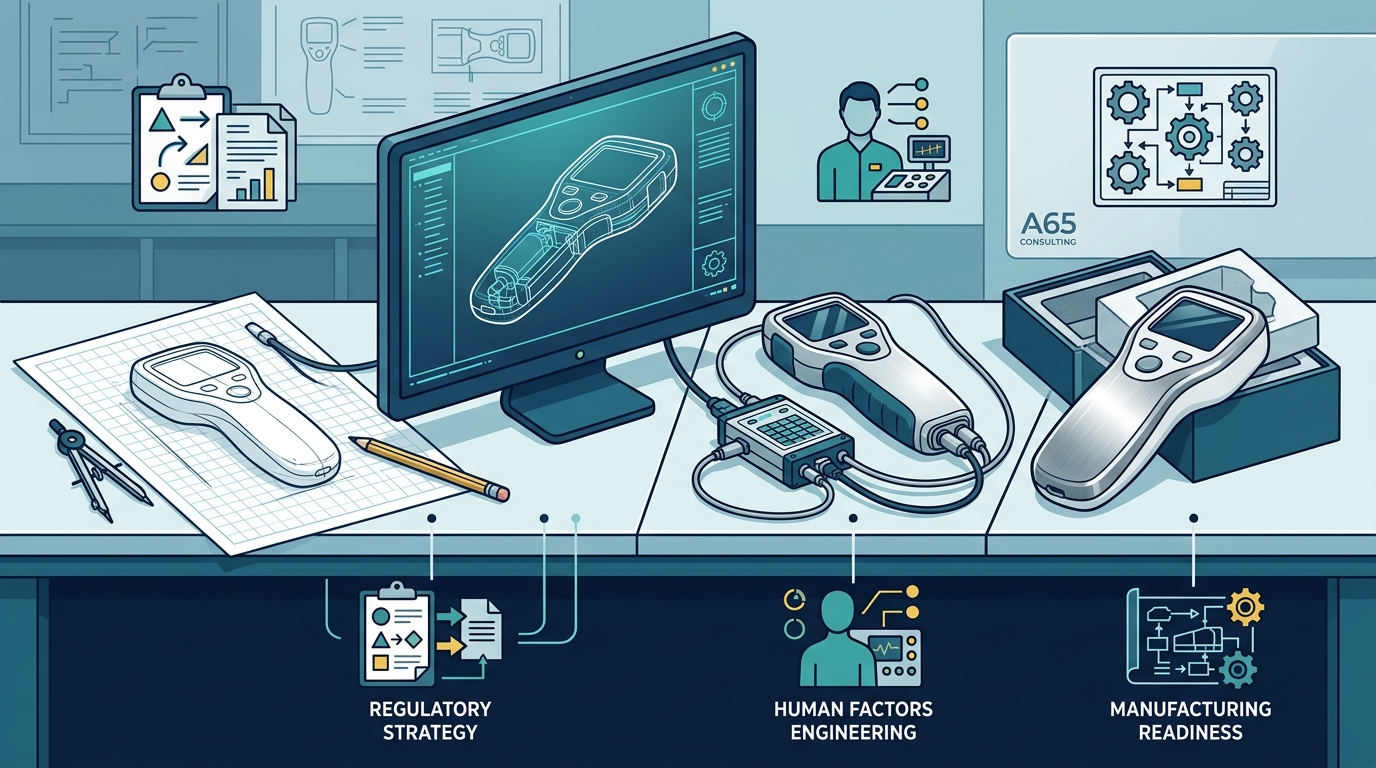
During this phase, engineers create detailed designs, including mechanical, electrical, and software components. Human factors engineering is integrated to ensure usability in clinical settings. Verification and validation testing are planned and executed to confirm that the device meets its specifications. Verification is a systematic process of confirming that design outputs meet design inputs through objective evidence.
Regulatory and Quality
Regulatory strategy is not an afterthought; it is woven into every design decision. Firms must be adept at navigating FDA 510(k) submissions, De Novo requests, or PMA applications. Quality management systems (QMS) must be established to ensure compliance with ISO 13485 standards. This phase requires meticulous documentation and risk management, including ISO 14971 compliance.
Manufacturing and Launch
The final phase involves transferring the design to a manufacturing partner or setting up internal production lines. This includes process validation, tooling design, and pilot runs. A successful launch requires seamless coordination between engineering and manufacturing to ensure consistent quality. Manufacturing transfer is the structured process of moving a product from development to full-scale production.
Critical Selection Criteria for Engineering Partners
Choosing the right engineering partner is one of the most significant decisions a medical device company will make. Several factors influence this choice.
Technical Breadth and Depth
The firm must possess expertise across multiple disciplines, including mechanical engineering, electronics, software development, and regulatory affairs. A siloed approach often leads to integration challenges. Look for teams that have successfully delivered devices in your specific therapeutic area. Experience with similar device classes reduces the learning curve and accelerates time to market.
Regulatory Track Record
Regulatory success is a key indicator of a firm's capability. Inquire about their history of successful FDA submissions and their approach to risk management. A firm that understands the regulatory landscape can anticipate hurdles and design around them proactively. According to industry data, regulatory delays account for 30% of project overruns in medical device development.
Manufacturing Integration
Design for Manufacturing (DFM) should be a core competency, not an add-on. The best firms engage manufacturing experts early to optimize designs for cost and producibility. This includes selecting appropriate materials, simplifying assembly, and ensuring tolerance stack-ups are manageable. DFM is a quality exercise that ensures the design can be consistently produced to specification.
The A65 Consulting Approach to Product Viability
A65 Consulting operates as a premium medical device engineering partner, specializing in turning device concepts into viable products. Our approach is built on decades of collective experience in medical device innovations and product development. We understand that engineering is not just about technical specifications; it is about solving complex challenges under tight deadlines and regulatory constraints.
We provide engineering leadership and expert support to help teams navigate complex product development with clarity and confidence. Our team integrates seamlessly with your internal staff, filling critical gaps in capability or capacity without the long-term commitment of full-time hires. This flexibility allows you to scale your engineering resources up or down based on project needs.
Our track record speaks to our commitment to results. We have served over 20 clients, with products developed contributing to more than $300 million of projected new product revenue. Furthermore, our designs have contributed to more than 8 FDA 510(k) submissions and created more than 10 new patent applications. We maintain a 90% on-time completion rate for mission-critical projects, demonstrating our ability to deliver under pressure.
Comparing Engagement Models
Understanding how different firms structure their engagements can help you make an informed decision. Below is a comparison of common models.
| Engagement Model | Best For | Pros | Cons |
|---|---|---|---|
| Fixed-Price Project | Well-defined scopes with clear requirements | Predictable costs, clear deliverables | Limited flexibility for changes |
| Monthly Retainer | Long-term development or team augmentation | Flexible resource allocation, ongoing support | Requires active management |
| Time and Materials | Early-stage R&D with evolving scope | High flexibility, rapid iteration | Cost uncertainty, requires oversight |
A65 Consulting typically charges on a monthly retainer basis, working toward mutually agreed-upon project milestones. This model aligns our incentives with your success, ensuring that we are focused on delivering value at every stage of the development process.
Key Takeaways
- End-to-end firms manage the entire lifecycle from concept to manufacturing transfer.
- Regulatory strategy must be integrated early to avoid costly delays.
- Design for Manufacturing (DFM) reduces production risks and costs.
- A65 Consulting has facilitated over $300M in projected revenue for clients.
- Our team has contributed to more than 8 FDA 510(k) submissions.
- We maintain a 90% on-time completion rate for critical projects.
- Monthly retainer models offer flexibility for evolving development needs.
Frequently Asked Questions
What is the typical timeline for end-to-end medical device design?
Timelines vary significantly based on device complexity and regulatory pathway. Simple Class I devices may take 6-12 months, while complex Class III devices can take 3-5 years. A65 Consulting helps streamline this process through rigorous planning and early risk mitigation.
How do you charge for your work?
We typically charge on a monthly retainer basis and work toward mutually agreed-upon project milestones. This ensures transparency and alignment with your development goals.
Do you have bandwidth to take on a new project?
Yes, we have a network of engineers that we utilize to bring in with the right discipline experience and to expand our resources as needed. We scale our team to match your project requirements.
What experience does A65 Consulting have designing medical devices similar to my project?
We have experience designing a wide variety of medical devices. Sometimes that experience is a direct fit, but even when it’s not, our broad range of experience affords us insight into many areas. We would be happy to share more details with you upon request.
How long has A65 Consulting been in business?
We’ve been working as a team since 2018, but our engineering team has decades of medical device development experience under their belts. Our collective expertise spans multiple therapeutic areas and regulatory pathways.
What is the role of human factors in device design?
Human factors engineering ensures that the device is safe and effective for its intended users. It involves usability testing and design iterations to minimize use-related errors. This is critical for regulatory approval and clinical adoption.
Can you help with manufacturing transfer?
Yes, we provide manufacturing support spanning process development, DFM reviews, and seamless production transition. We ensure that the design is optimized for manufacturability before handoff.
Start Your Development Journey
Transforming a medical device concept into a market-ready product requires a partner who understands both the technical and regulatory complexities. A65 Consulting offers the expertise, flexibility, and proven track record to guide you through every phase of development. We are committed to delivering results that exceed your expectations.
Ready to discuss your project? Book a consultation with our team to explore how we can help you achieve your product development objectives. Visit our services page to learn more about our capabilities.