Accelerate Medical Device Manufacturing Transfer: A Strategic 2026 Guide
Manufacturing transfer is the most critical juncture in the medical device lifecycle, yet it remains the primary source of program delays. Industry data shows that nearly 90% of complex device programs face significant bottlenecks during the transition from prototype to production. For startups, this phase is not merely a logistical step but a survival metric. The difference between a successful launch and a capital-burning failure often lies in how early and how rigorously Design for Manufacturing (DfM) principles are integrated into the development cycle.
Why DfM Is a Quality Exercise, Not Just a Cost One
Design for Manufacturing (DfM) is often introduced as a cost reduction activity. It shows up when margins tighten, when sourcing changes, or when a program is already under pressure. At that point, teams look for ways to make the product cheaper to produce. However, this reactive approach is a fundamental error. Recent analysis indicates that DfM should be viewed primarily as a quality exercise. When manufacturing constraints are ignored during the design phase, the resulting product often requires extensive rework, leading to delayed timelines and compromised regulatory compliance.
For medical device startups, the goal is not just to lower the unit cost but to ensure the design can be reproduced consistently at scale. This requires a shift in mindset. Instead of asking "How can we make this cheaper?" engineers must ask "How can we make this manufacturable?" This distinction is vital for accelerating the transfer process. By embedding manufacturing knowledge early, teams can avoid the "valley of death" where prototypes work perfectly in the lab but fail miserably on the production line.
The integration of DfM also impacts the supply chain. Complex geometries or rare materials may work for a prototype but are impossible to source for mass production. Early engagement with manufacturing partners allows for the identification of these risks before they become critical path items. This proactive stance reduces the need for late-stage design changes, which are notoriously expensive and time-consuming in regulated environments.
Treating Verification as a System, Not a Phase
Most development teams treat verification as something that happens near the end of a program. It is planned, scheduled, and executed as a step to confirm that the design meets requirements. In that model, verification is a gate. If you pass, you move to manufacturing. If you fail, you go back to design. This binary approach is inefficient and dangerous for startups with limited runway.
Engineering best practices suggest that verification must be treated as a continuous system. This means verifying manufacturing processes alongside the product design. When verification is siloed, teams often discover that the test methods used for prototypes are not viable for production. This discovery forces a redesign of both the product and the test fixtures, doubling the effort required.
To accelerate transfer, startups should implement iterative verification cycles. Each design iteration should be tested against the intended manufacturing process. This approach ensures that the design is not only functionally sound but also verifiable using production-grade equipment. By aligning verification strategies with manufacturing capabilities from day one, teams can eliminate the "surprise" failures that typically derail launch timelines.
The Risk Analysis Paradox in Manufacturing
In regulated product development, risk analysis is one of the most formalized engineering activities. Hazard analyses are created, risk matrices are populated, and mitigation tables are carefully maintained. Yet many design problems emerge during manufacturing transfer that were not captured in the initial risk assessment. This is known as the Risk Analysis Paradox.
The paradox occurs because traditional risk analysis focuses on clinical use and patient safety. It often overlooks the risks associated with the manufacturing process itself. For example, a device may be safe for the patient but impossible to assemble without causing damage to sensitive components. These manufacturing risks are rarely identified until the first production run.
To break this paradox, startups must expand their risk analysis to include process hazards. This involves mapping every step of the manufacturing process and identifying potential failure modes at each stage. By integrating process risk analysis with product risk analysis, teams can develop mitigations that address both clinical and manufacturing concerns simultaneously. This holistic approach reduces the likelihood of late-stage surprises and accelerates the path to regulatory approval.
Designing the Product and the Process Together
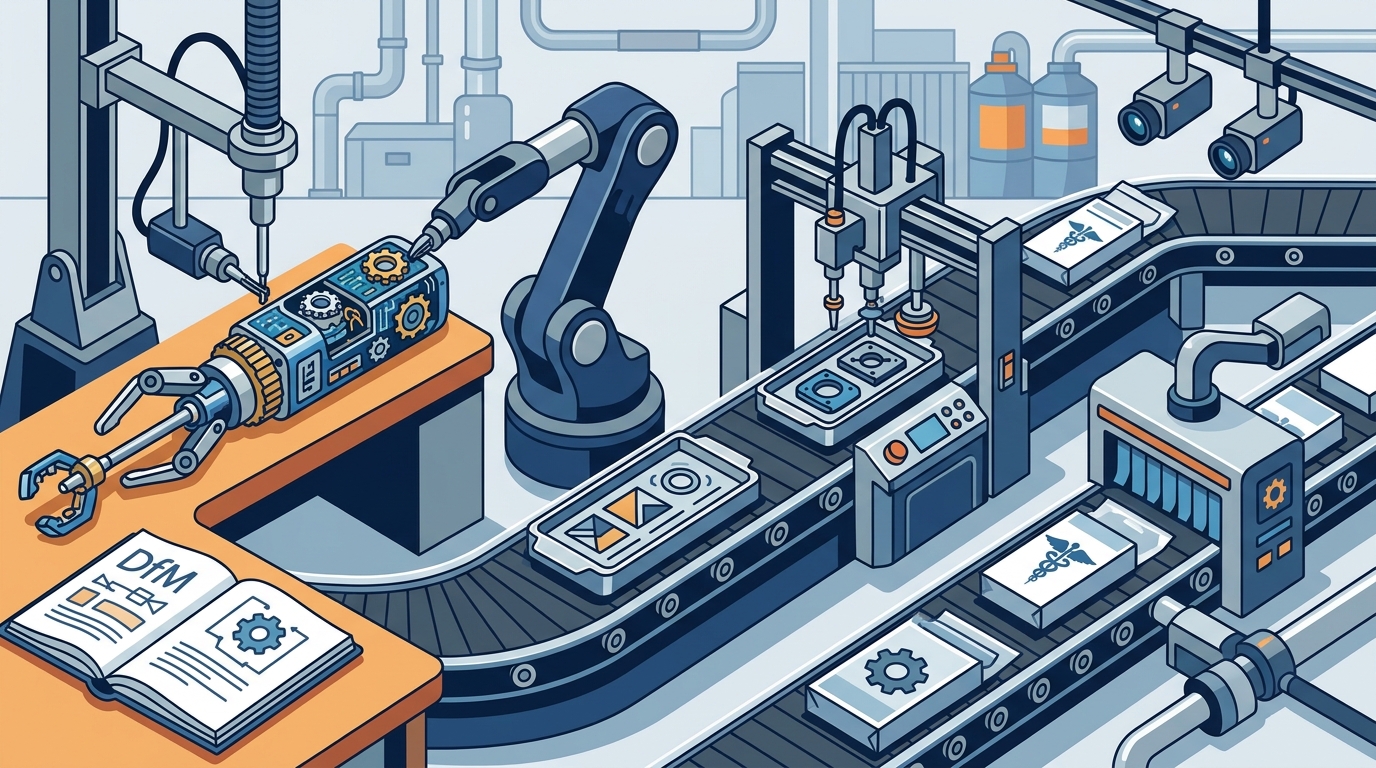
Believing in DfM is not the same as doing it. Many development leaders agree that design and manufacturing should be integrated, yet they remain siloed in practice. This separation creates a gap where the product design is optimized for performance, while the manufacturing process is optimized for efficiency. The result is a compromise that satisfies neither goal.
Industry reports confirm that the most successful device launches occur when the product and the process are designed together. This requires a collaborative environment where manufacturing engineers are involved in the early design phases. They provide input on material selection, tolerance stack-ups, and assembly sequences. This input is then fed back into the design, ensuring that the product is inherently manufacturable.
For startups, this collaboration often requires external expertise. Internal teams may have deep knowledge of the clinical need but lack experience in large-scale production. Bringing in manufacturing experts early allows for the co-development of the product and the process. This synergy ensures that the design is not only innovative but also scalable. It also reduces the need for extensive rework during the transfer phase, saving both time and capital.
When Engineering Outsourcing Accelerates Transfer
Outsourcing is often presented as a straightforward way to move faster. If a program needs more speed, add external resources. If specialized expertise is missing, bring in a partner. If timelines are tight, increase capacity. Sometimes this works exactly as intended. However, outsourcing can also slow down development if not managed correctly.
Strategic insights indicate that outsourcing accelerates transfer when it provides access to specific capabilities that are not available in-house. For medical device startups, this often means access to specialized manufacturing processes, regulatory knowledge, or project management expertise. The key is to choose partners who understand the unique constraints of medical device development.
When selecting an outsourcing partner, startups should look for firms that offer end-to-end support. This includes not just design and manufacturing, but also regulatory strategy and quality assurance. A partner who can navigate the complexities of FDA 510(k) submissions or CE marking can significantly reduce the time to market. Additionally, a partner with a network of manufacturing resources can help scale production quickly, ensuring that the device is ready for launch when the regulatory approval is granted.
Manufacturing Transfer Strategies Comparison
Choosing the right approach for manufacturing transfer depends on the specific needs of the device and the startup. Below is a comparison of common strategies to help guide decision-making.
| Strategy | Best For | Pros | Cons |
|---|---|---|---|
| In-House Transfer | Startups with existing manufacturing infrastructure | Full control over quality and timeline | High capital expenditure, limited scalability |
| Contract Manufacturing (CMO) | Devices requiring specialized production | Access to expertise, lower upfront cost | Less control, potential IP risks |
| Engineering Partner | Complex devices needing DfM integration | Early DfM input, regulatory support | Requires strong partnership management |
| Hybrid Model | Startups scaling from prototype to mass production | Flexibility, balanced risk | Complex coordination, higher management overhead |
Key Takeaways
- DfM is Quality First: Design for Manufacturing should be prioritized as a quality assurance measure to prevent late-stage rework and ensure consistent production.
- Verification is Continuous: Treat verification as an ongoing system integrated with design, rather than a final phase, to catch manufacturing viability issues early.
- Risk Analysis Must Expand: Include process hazards in risk analysis to identify manufacturing failures that traditional clinical risk assessments miss.
- Co-Design is Critical: Product and process design must occur simultaneously to ensure the device is both innovative and scalable.
- Strategic Outsourcing: Use engineering partners to fill capability gaps, particularly in regulatory strategy and specialized manufacturing, to accelerate timelines.
- Early Partner Engagement: Engaging manufacturing experts during the concept phase can reduce development time by identifying constraints before they become critical.
- Regulatory Alignment: Align manufacturing transfer activities with regulatory submission requirements to avoid delays in approval.
Frequently Asked Questions
How early should DfM be integrated into the design process?
DfM should be integrated as early as the conceptual design phase. Early integration allows manufacturing constraints to influence design decisions, preventing costly changes later in the development cycle.
What is the biggest risk in manufacturing transfer for startups?
The biggest risk is the disconnect between the prototype design and the production process. This often leads to issues with scalability, consistency, and regulatory compliance.
How can startups verify their manufacturing process before full production?
Startups can use pilot runs and process validation studies to verify the manufacturing process. These studies help identify potential failures and ensure the process is capable of meeting quality standards.
When is it better to use a contract manufacturer vs. an engineering partner?
Contract manufacturers are best for established designs requiring production capacity. Engineering partners are better for complex devices needing DfM integration and regulatory support during the development phase.
How does risk analysis impact manufacturing transfer?
Risk analysis identifies potential failures in both the product and the process. By addressing these risks early, teams can develop mitigations that prevent delays and ensure a smooth transfer.
What role does regulatory strategy play in manufacturing transfer?
Regulatory strategy ensures that the manufacturing process meets all compliance requirements. Aligning transfer activities with regulatory submissions helps avoid delays in approval and market entry.
Can outsourcing slow down development?
Yes, if not managed correctly. Outsourcing can slow development if the partner lacks medical device expertise or if communication is poor. Choosing the right partner is crucial for acceleration.
Next Steps for Your Device
Accelerating manufacturing transfer requires more than just technical expertise. It demands a strategic approach that integrates design, process, and regulatory considerations from the very beginning. For medical device startups, partnering with an experienced engineering firm can provide the necessary guidance and resources to navigate this complex landscape.
A65 Consulting specializes in helping startups transform device concepts into viable products. Our team of experts provides end-to-end support, from design for manufacturing to regulatory strategy. We understand the unique challenges faced by startups and are committed to delivering results that exceed expectations.
Do not let manufacturing transfer become a bottleneck in your success. Book a consultation today to discuss how we can help you accelerate your path to market.