
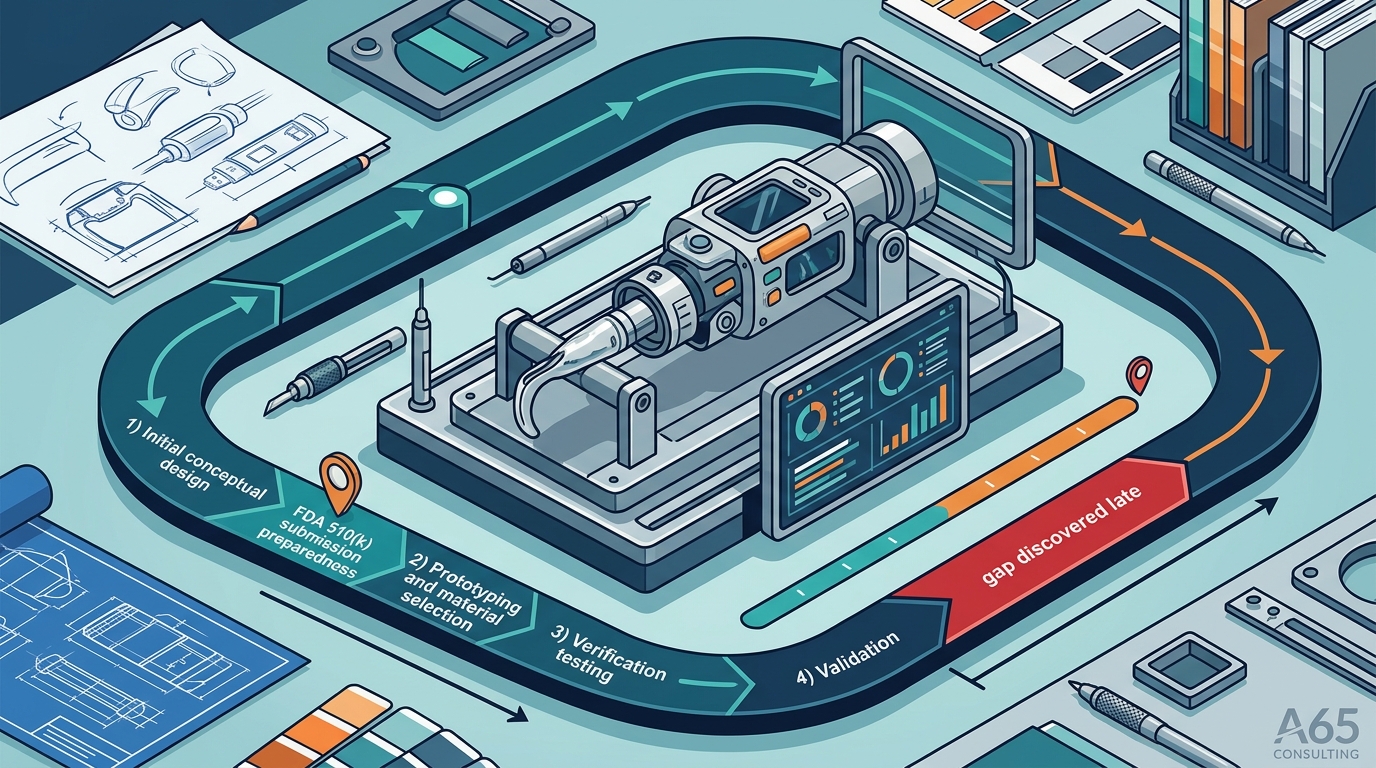
Regulatory compliance is not a final checkpoint but a continuous engineering discipline that begins at the moment of concept generation. According to recent industry analyses, FDA 510(k) submissions have seen a significant increase in review cycles, demanding that engineering teams produce more rigorous documentation from day one. The average medical device project faces a 20 to 30 percent timeline extension when compliance gaps are discovered late in the development cycle. This statistic underscores the critical need for integrating regulatory strategy into the initial design phase rather than treating it as an afterthought. Companies that fail to align their engineering workflows with these standards risk costly redesigns, delayed market entry, and potential regulatory rejection. This guide outlines the precise engineering frameworks required to navigate this complex landscape successfully. (Contact A65 Consulting)
Understanding Regulatory Frameworks
The foundation of any compliant medical device lies in a deep understanding of the applicable regulatory frameworks. ISO 13485 defines the quality management systems necessary for the design and manufacture of medical devices. This standard mandates that organizations maintain strict control over their processes to ensure consistent product quality. Without this foundational system, subsequent engineering efforts lack the necessary oversight to guarantee safety and efficacy. (Services A65 Consulting)
For devices entering the United States market, the Premarket Submission process is the primary gateway. This pathway requires engineers to demonstrate that their device is substantially equivalent to a legally marketed predicate device. The complexity of this demonstration depends heavily on the device class. Class II devices typically require a 510(k) submission, while Class III devices demand a more rigorous Premarket Approval (PMA) process. Understanding these distinctions early allows engineering teams to allocate resources appropriately and avoid unnecessary regulatory burdens. (Medical Device Design Consulting)
International markets impose their own stringent requirements. The European Union’s Medical Device Regulation (MDR) has replaced the older Medical Device Directive (MDD), introducing stricter clinical evaluation requirements and enhanced post-market surveillance obligations. Engineers must account for these global variations from the outset. A design that complies with FDA standards may still fail to meet MDR requirements if specific clinical data or usability testing protocols are not included in the initial design plan. Aligning these frameworks early prevents costly redesigns later in the product lifecycle.
Design Controls and Documentation
Design controls are the structured processes that ensure medical devices are designed and tested according to user needs and intended uses. ISO 14971 provides the primary framework for risk management, which is intrinsically linked to design controls. These controls require rigorous documentation at every stage of development. This documentation serves as the legal evidence that the device was developed safely and effectively.
The design history file (DHF) is a critical component of this process. It contains the raw data and records that demonstrate the design was developed according to the design plan. Every change to the design must be documented, reviewed, and approved. This traceability ensures that any deviation from the original plan is justified and validated. Engineering teams must maintain this documentation meticulously to withstand regulatory audits. A gap in the DHF can lead to a complete rejection of the submission, regardless of the device's technical merit.
User needs and intended use statements form the basis of the design inputs. These inputs must be clear, measurable, and verifiable. Ambiguous requirements lead to ambiguous designs, which in turn lead to failed verification tests. Engineering teams must work closely with clinical experts to define these needs accurately. This collaboration ensures that the device not only meets regulatory standards but also solves the actual clinical problem it was designed to address. Clear design inputs reduce the risk of scope creep and ensure that the final product aligns with market expectations.
Risk Management Integration
Risk management is not a separate activity but an integral part of the design process. ISO 14971 outlines the process for identifying hazards, estimating risks, and implementing controls. This process must begin during the conceptual phase and continue throughout the product lifecycle. Engineers must identify all potential hazards associated with the device, including those related to use, misuse, and environmental conditions.
Once hazards are identified, risk control measures must be implemented. These measures can include inherent safe design, protective measures, or information for safety. The goal is to reduce the risk to an acceptable level. If the risk cannot be reduced to an acceptable level, the device may not be viable. Engineering teams must document all risk analysis activities, including the rationale for accepting residual risks. This documentation is essential for regulatory review and demonstrates a thorough understanding of the device's safety profile.
Usability engineering plays a crucial role in risk management. Human factors testing helps identify potential use errors that could lead to harm. By involving end-users in the design process, engineers can identify and mitigate risks related to device operation. This proactive approach to usability reduces the likelihood of use-related errors in the clinical setting. It also strengthens the regulatory submission by providing robust evidence of user safety.
Verification and Validation
Verification and validation are distinct but complementary processes that ensure the device meets its design inputs and intended use. ISO 13485 requires that verification activities confirm that design outputs meet design inputs. This process involves testing, inspection, or demonstration to ensure that each design requirement has been satisfied. Verification answers the question, "Did we build the device right?"
Validation, on the other hand, confirms that the device meets user needs and intended uses. It answers the question, "Did we build the right device?" Validation typically involves clinical evaluation or simulated use testing. This process ensures that the device performs as expected in the real-world environment. Both verification and validation must be planned, executed, and documented rigorously. Any failures during these stages must be addressed through design changes or risk mitigation strategies.
The integration of verification and validation into the development timeline is critical. Delaying these activities until the end of the project can lead to significant delays and cost overruns. Engineering teams should adopt an iterative approach, testing early and often. This approach allows for the identification and resolution of issues while they are still manageable. It also provides continuous feedback to the design team, ensuring that the final product is both compliant and effective.
Manufacturing Transfer and Quality
Transferring the design to manufacturing is a critical phase that requires careful planning and execution. The design transfer process ensures that the device can be produced consistently according to the design specifications. This involves defining the manufacturing processes, equipment, and quality control measures. Engineering teams must work closely with manufacturing engineers to ensure that the design is manufacturable and that quality can be maintained at scale.
Design for Manufacturing (DFM) is a key consideration during this phase. DFM involves designing the product in a way that facilitates efficient and cost-effective manufacturing. This includes considerations such as material selection, component standardization, and assembly simplicity. By incorporating DFM principles early, engineering teams can reduce manufacturing costs and improve product quality. This proactive approach also helps to identify potential manufacturing issues before they become costly problems.
Quality management systems must be in place to support the manufacturing process. This includes procedures for incoming material inspection, in-process testing, and final product release. Engineering teams must ensure that these procedures are robust and effective. Regular audits and reviews help to identify areas for improvement and ensure continued compliance. A strong quality management system is essential for maintaining regulatory compliance and ensuring patient safety throughout the product lifecycle.
Key Takeaways
- A65 Consulting has contributed to more than 8 FDA 510(k) submissions, demonstrating proven expertise in regulatory navigation.
- Products developed by A65 have contributed to more than $300M of projected new product revenue, highlighting the financial impact of compliant design.
- Design for Manufacturing is a quality exercise, not just a cost reduction activity, ensuring consistent product performance.
- Verification is a system, not a phase, requiring continuous integration throughout the development lifecycle.
- Risk analysis must actively change the design to be effective, rather than serving as a static documentation exercise.
- A65 Consulting has maintained a 90% on-time completion rate for mission-critical projects, ensuring timely market entry.
- The engineering team has decades of medical device development experience, providing deep institutional knowledge for complex regulatory challenges.
Frequently Asked Questions
How does A65 Consulting approach regulatory compliance during the design phase?
A65 Consulting integrates regulatory strategy from the initial concept phase. We ensure that design inputs align with FDA and ISO standards, preventing costly late-stage revisions. Our team utilizes rigorous design controls to maintain traceability and documentation integrity throughout the development lifecycle.
What is the role of risk management in medical device design?
Risk management is central to compliant design. We apply ISO 14971 standards to identify hazards and implement controls early in the process. This proactive approach ensures that safety is built into the device rather than added as an afterthought, reducing the likelihood of regulatory rejection.
How do you handle design for manufacturing (DFM) in regulated environments?
We treat DFM as a quality exercise. By involving manufacturing experts early, we ensure that the design can be produced consistently and to specification. This includes rigorous DFM reviews and process development to support seamless production transition.
What is the difference between verification and validation?
Verification confirms that the device meets its design inputs (did we build it right?). Validation confirms that the device meets user needs and intended use (did we build the right device?). Both are critical for regulatory compliance and require distinct planning and execution strategies.
How long has A65 Consulting been in the medical device industry?
While our team has decades of collective experience, A65 Consulting has been operating as a unified team since 2018. Our founders and principal consultants bring extensive historical data and proven methodologies to every project.
Can A65 Consulting help with FDA 510(k) submissions?
Yes, we have extensive experience supporting clients through the 510(k) process. Our track record includes contributions to more than 8 successful submissions. We provide the engineering leadership and documentation support necessary to navigate this complex regulatory pathway.
What is your pricing model for engineering services?
We typically charge on a monthly retainer basis, working toward mutually agreed upon project milestones. This model provides flexibility and aligns our incentives with your project goals, ensuring transparent and predictable costs.
Partner with A65 Consulting for Compliant Design
Navigating the complexities of medical device regulation requires more than just technical expertise. It demands a strategic partner who understands the stakes. A65 Consulting offers the engineering leadership and rigorous quality management necessary to bring your device to market safely and efficiently. We help you transform your concept into a viable product that meets all regulatory requirements. Book a consultation today to discuss your project and discover how we can accelerate your path to compliance.