
What Makes the Difference Between Cost Reduction That Works and Strategies That Backfire?
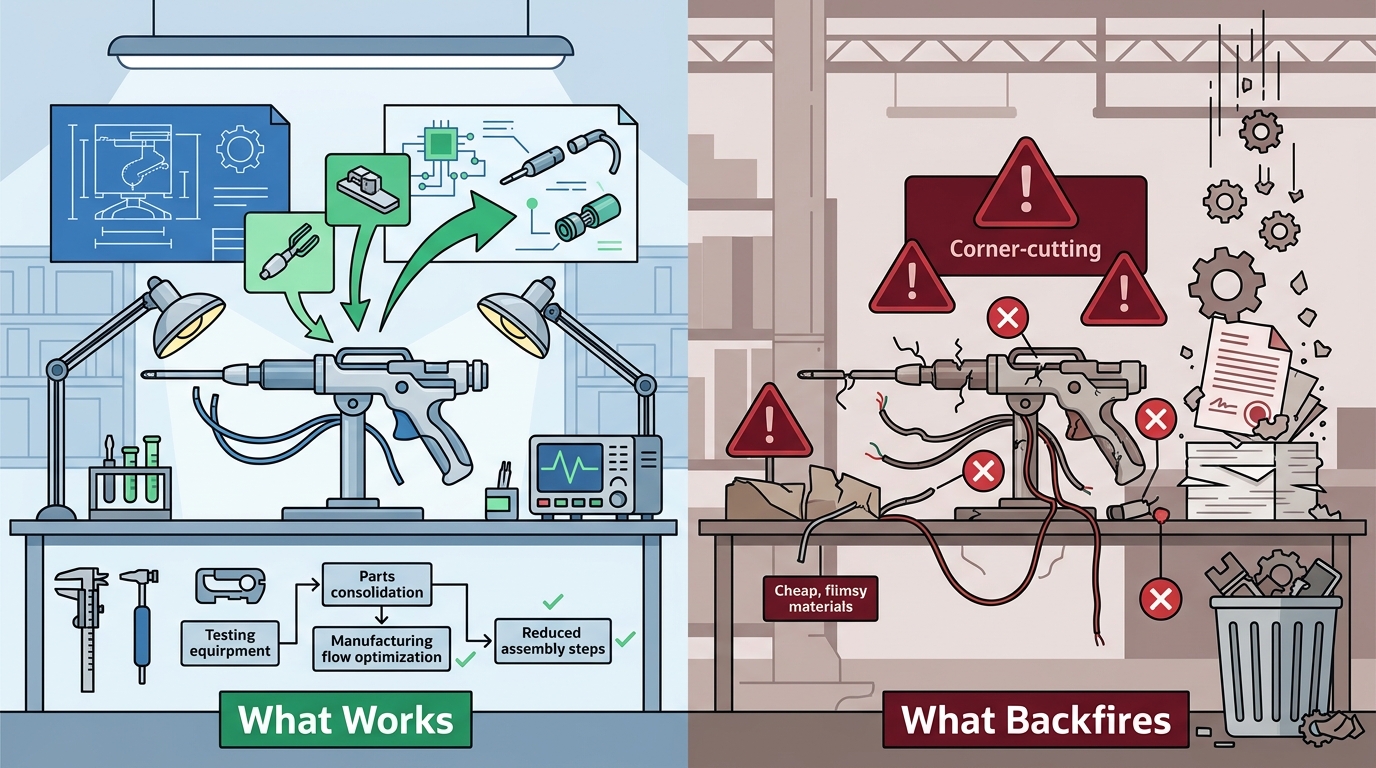
Effective cost reduction in medical device development focuses on engineering efficiency and design for manufacturability, whereas backfiring strategies rely on cutting corners that compromise safety or regulatory compliance. A65 Consulting emphasizes that sustainable savings come from optimizing the product architecture and manufacturing process, not from arbitrary budget cuts that create downstream liabilities. according to The Inflation Reduction
The Trap of Arbitrary Budget Cuts
Many development teams approach cost reduction as a financial exercise rather than an engineering one. They set a target price and force the design to fit that number, often ignoring the physical realities of the device. This approach frequently leads to design for cost errors, where the product is cheap to build but expensive to maintain or repair. When a device fails in the field due to a cost-cutting measure, the resulting liability far exceeds the initial savings.
For example, reducing the wall thickness of a polymer housing to save material costs can lead to stress cracking under normal use. This type of failure triggers recalls and regulatory scrutiny. The implication is clear: cost targets must be derived from engineering analysis, not imposed as arbitrary constraints.
Design for Manufacturing as a Quality Exercise
True cost optimization begins with Design for Manufacturing (DFM), which is the process of designing a product to be manufactured efficiently and reliably. DFM is not just about saving money; it is a quality exercise that reduces variation and improves yield. By simplifying geometries and reducing part counts, engineers can lower the cost of goods sold (COGS) while simultaneously improving product reliability.
A concrete example involves reducing the number of fasteners in an assembly. Instead of using ten screws to hold a housing together, a design might use two clips and a snap-fit mechanism. This reduces assembly time, eliminates the need for torque tools, and lowers the risk of fastener failure. The result is a lower unit cost and a more robust product.
The Danger of Late-Stage Changes
One of the most common reasons cost reduction strategies backfire is the timing of the changes. Making significant design modifications late in the development cycle is extremely expensive. Tooling changes, re-verification, and regulatory updates can wipe out any savings gained from the design change. This is known as the cost of change curve, which shows that the cost to modify a design increases exponentially as the project progresses.
Consider a scenario where a team decides to switch from a metal to a plastic component six months before launch. While the plastic part is cheaper, the team must re-qualify the supplier, re-run verification tests, and potentially update the regulatory submission. The total cost of this change often exceeds the savings from the material switch. Early engagement with manufacturing partners is essential to avoid this trap.
Balancing Performance and Cost
For instance, a medical device might use a high-grade stainless steel for a non-critical internal bracket. Switching to a lower-grade steel or a high-strength polymer can reduce costs significantly, provided the bracket does not bear critical loads. This targeted approach ensures that resources are spent where they matter most.
The Role of Interim Leadership
Effective cost reduction often requires strong leadership and clear communication. Interim engineering leaders can provide the objectivity and experience needed to navigate the trade-offs between cost, quality, and schedule. They can facilitate cross-functional collaboration, ensuring that manufacturing, quality, and engineering teams are aligned on the goals and constraints. This leadership is crucial for maintaining momentum and preventing scope creep.
A65 Consulting provides interim leadership and engineering expertise to help clients navigate these complex decisions. By bringing in experienced professionals, companies can accelerate their cost optimization efforts while maintaining high standards of quality and compliance. This approach ensures that cost reduction is a strategic advantage, not a source of risk.
Key Takeaways
- Cost reduction should be an engineering exercise, not a financial one.
- Design for Manufacturing (DFM) improves both cost and quality.
- Late-stage design changes are expensive and risky.
- Focus cost reduction efforts on non-critical-to-quality features.
- Value engineering balances performance and cost effectively.
- Strong leadership is essential for successful cost optimization.
- Early engagement with manufacturing partners prevents costly surprises.
Frequently Asked Questions
What is the most common mistake in medical device cost reduction?
The most common mistake is treating cost reduction as a financial target rather than an engineering process. This often leads to design compromises that compromise safety or reliability.
How does Design for Manufacturing (DFM) help with cost reduction?
DFM helps by simplifying the design, reducing part counts, and optimizing the manufacturing process. This leads to lower production costs and higher yields.
When is the best time to start cost optimization?
The best time to start cost optimization is during the conceptual design phase. Changes made early in the process are significantly cheaper than those made later.
Can cost reduction compromise regulatory compliance?
Yes, if not managed carefully. Cost-cutting measures that affect safety or performance can lead to regulatory issues. It is essential to validate any changes against regulatory requirements.
What is value engineering?
Value engineering is a systematic process of analyzing a product to improve its value by reducing cost without sacrificing performance or quality.
How can interim leadership help with cost optimization?
Interim leadership provides the experience and objectivity needed to navigate complex trade-offs. They can facilitate cross-functional collaboration and ensure that cost reduction efforts are aligned with business goals.
Conclusion
The difference between cost reduction that works and strategies that backfire lies in the approach. Successful cost reduction is rooted in engineering principles, early planning, and a deep understanding of the product's critical characteristics. By focusing on Design for Manufacturing and value engineering, companies can achieve sustainable savings without compromising quality or safety. A65 Consulting offers expert guidance and interim leadership to help you navigate these challenges. to discuss how we can help you optimize the cost of your medical device product.