
Value Engineering in Medical Devices: Cutting Costs Without Compromising Quality
Value engineering reduces medical device manufacturing costs by systematically analyzing functions to eliminate unnecessary complexity while preserving critical performance. This approach ensures that every design element serves a specific purpose, directly impacting the bottom line without introducing safety risks. A65 Consulting applies these rigorous engineering principles to help device companies optimize their products for both market viability and regulatory compliance.
The Core Philosophy of Value Engineering
Value engineering is a systematic method used to improve the "value" of goods or products by examining their function. In the medical device sector, this means looking beyond simple cost-cutting to understand the relationship between cost and function. The goal is not to make a product cheaper at the expense of performance, but to achieve the required function at the lowest possible cost. This distinction is critical for manufacturers who must balance financial targets with strict quality standards.
Traditional cost reduction often involves removing materials or simplifying processes in a reactive manner. Value engineering, however, is proactive and function-driven. It asks what the part or system must do before deciding how to build it. By focusing on function, engineers can identify redundant features that add cost but provide no clinical or user benefit. This methodical approach ensures that cost savings are structural rather than superficial.
For medical device companies, this philosophy shifts the conversation from "how do we make this cheaper?" to "how do we make this more efficient?" The result is a product that is easier to manufacture, more reliable, and often more user-friendly. A65 Consulting integrates this function-first mindset into every project, ensuring that cost optimization is a design feature, not an afterthought.
Function Analysis and Design Simplification
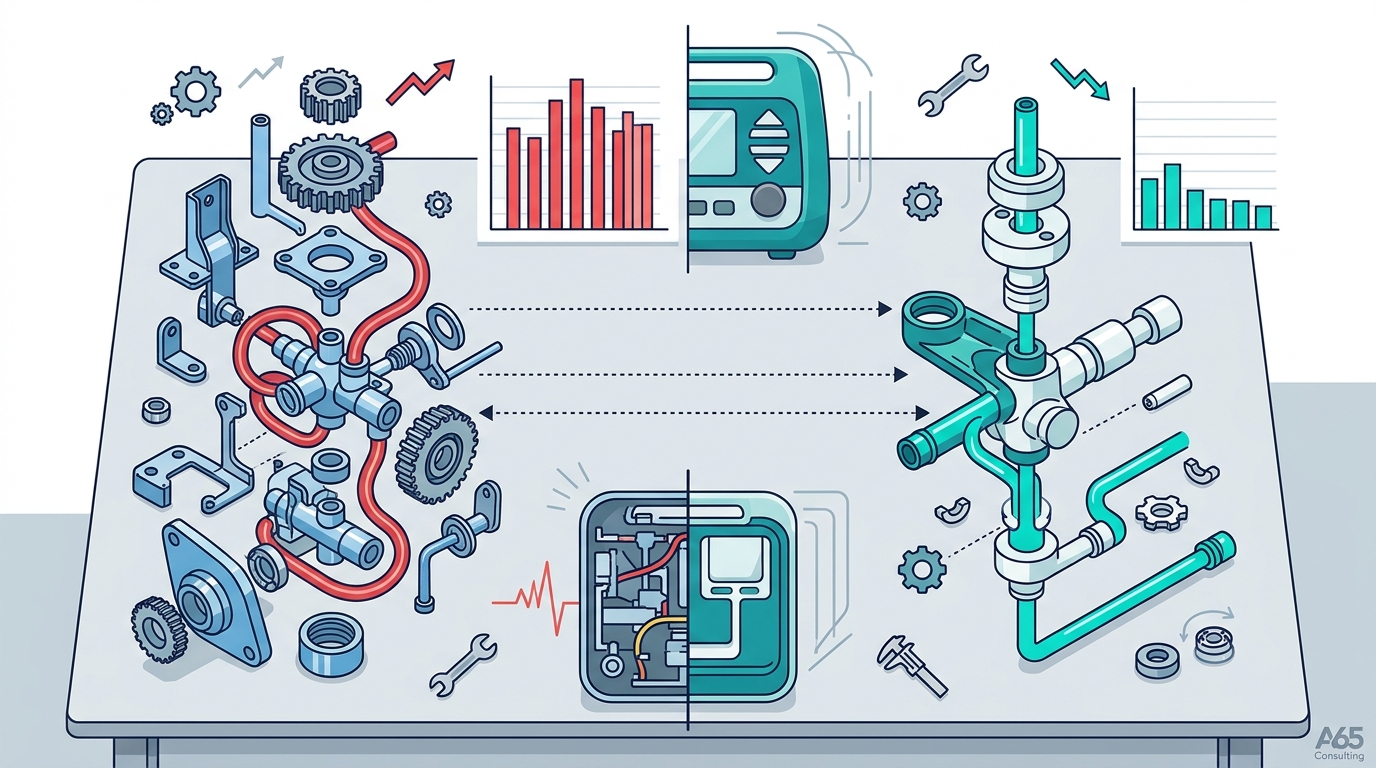
The first step in value engineering is a detailed function analysis. Engineers break down the device into its constituent parts and define the primary and secondary functions of each component. This process reveals which elements are essential to the device's operation and which are merely convenient or aesthetic. By mapping these functions, teams can identify opportunities to combine parts, eliminate unnecessary features, or select more efficient materials.
Design simplification is a direct outcome of this analysis. For example, a complex assembly with multiple fasteners might be replaced by a single injection-molded component that performs the same function. This reduction in part count not only lowers material costs but also reduces assembly time and the potential for human error during manufacturing. In a recent project, A65 Consulting worked with a client to simplify a probe housing, reducing the number of components by 30% while maintaining all required structural integrity.
This level of simplification has significant implications for quality. Fewer parts mean fewer potential failure points. It also makes the manufacturing process more consistent, which is crucial for meeting regulatory requirements. By streamlining the design, manufacturers can achieve higher first-pass yields and reduce the need for rework, further lowering costs.
Material Selection and Process Optimization
Material selection is another area where value engineering delivers significant cost savings. Engineers evaluate various materials based on their ability to meet functional requirements at the lowest cost. This often involves moving from expensive, high-performance materials to more cost-effective alternatives that still meet the necessary specifications. For instance, a device component that does not require biocompatibility might be made from a standard polymer rather than a specialized medical-grade material.
Process optimization involves choosing the most efficient manufacturing method for each component. This might mean switching from machining to injection molding for high-volume parts, or using additive manufacturing for complex geometries that would be difficult to machine. The choice of process must align with the production volume and quality requirements. A65 Consulting's manufacturing engineering team specializes in these decisions, ensuring that the chosen process supports both cost targets and quality standards.
The implication of smart material and process selection is a more robust and predictable manufacturing operation. When materials and processes are optimized for the specific function, the resulting product is less likely to fail under normal use conditions. This reliability reduces warranty claims and returns, which are hidden costs that can erode the savings achieved through initial cost reduction.
Quality Assurance and Regulatory Compliance
A common concern with cost reduction is the potential impact on quality and regulatory compliance. Value engineering addresses this by integrating quality considerations into the design phase. Every change made during the value engineering process is evaluated for its impact on safety, efficacy, and regulatory requirements. This ensures that cost savings do not come at the expense of patient safety or product performance.
Regulatory compliance is a non-negotiable aspect of medical device development. Changes to a design, even if they reduce cost, must be documented and validated to ensure they do not introduce new risks. A65 Consulting's system engineering team works closely with quality and regulatory teams to ensure that all value engineering changes are properly documented and tested. This proactive approach to compliance prevents costly delays and rework later in the development process.
The implication of this integrated approach is a product that is both cost-effective and compliant. By treating quality and regulatory compliance as design constraints rather than post-design checks, manufacturers can achieve cost savings without compromising their ability to bring the product to market. This is particularly important for companies that are preparing for FDA 510(k) submissions or other regulatory pathways.
Long-Term Financial Impact
The financial benefits of value engineering extend beyond the initial manufacturing cost. By creating a more efficient and reliable product, manufacturers can reduce costs across the entire product lifecycle. This includes lower maintenance costs, reduced downtime, and improved customer satisfaction. These long-term benefits can significantly improve the return on investment for the device.
For example, a device that is easier to assemble and maintain will have lower labor costs over its lifetime. It will also be less likely to require field repairs or recalls, which are extremely expensive and damaging to a company's reputation. A65 Consulting has seen clients achieve significant long-term savings through value engineering, with some projects resulting in cost reductions of 20% or more without any impact on performance.
The implication of these long-term savings is a more sustainable business model. By reducing costs and improving reliability, manufacturers can offer more competitive pricing while maintaining healthy profit margins. This is essential for success in the highly competitive medical device market. A65 Consulting helps clients achieve this balance, ensuring that their products are both financially viable and clinically effective.
Key Takeaways
- Value engineering is a function-driven approach to cost reduction that preserves performance.
- Design simplification reduces part count, assembly time, and potential failure points.
- Smart material and process selection can lower costs without compromising quality.
- Integrating quality and regulatory considerations into the design phase prevents costly delays.
- Long-term savings from value engineering improve the overall return on investment.
- A65 Consulting provides expert guidance on value engineering for medical device companies.
Frequently Asked Questions
What is the main difference between value engineering and cost cutting?
Value engineering focuses on improving the function-to-cost ratio, while cost cutting often involves reducing costs without regard for function. Value engineering ensures that performance is maintained, whereas cost cutting can lead to quality issues.
Can value engineering be applied to existing products?
Yes, value engineering can be applied to both new and existing products. For existing products, it can identify opportunities to reduce costs and improve performance without requiring a complete redesign.
How does value engineering impact regulatory compliance?
Value engineering changes must be documented and validated to ensure they do not introduce new risks. A65 Consulting works with regulatory teams to ensure that all changes are compliant with FDA and other regulatory requirements.
What are the typical cost savings from value engineering?
Cost savings vary depending on the product and the extent of the changes. However, it is common to see savings of 10-30% through value engineering without any impact on performance.
How long does a value engineering project take?
The duration of a value engineering project depends on the complexity of the product and the scope of the changes. A simple project might take a few weeks, while a more complex one could take several months.
Partnering for Cost-Effective Innovation
Value engineering is a powerful tool for reducing medical device manufacturing costs without sacrificing quality. By focusing on function, simplifying design, and optimizing materials and processes, manufacturers can achieve significant cost savings while maintaining high standards of performance and compliance. A65 Consulting brings decades of experience in medical device engineering to this process, ensuring that your product is both cost-effective and clinically effective. To learn more about how value engineering can benefit your device, for a consultation.