
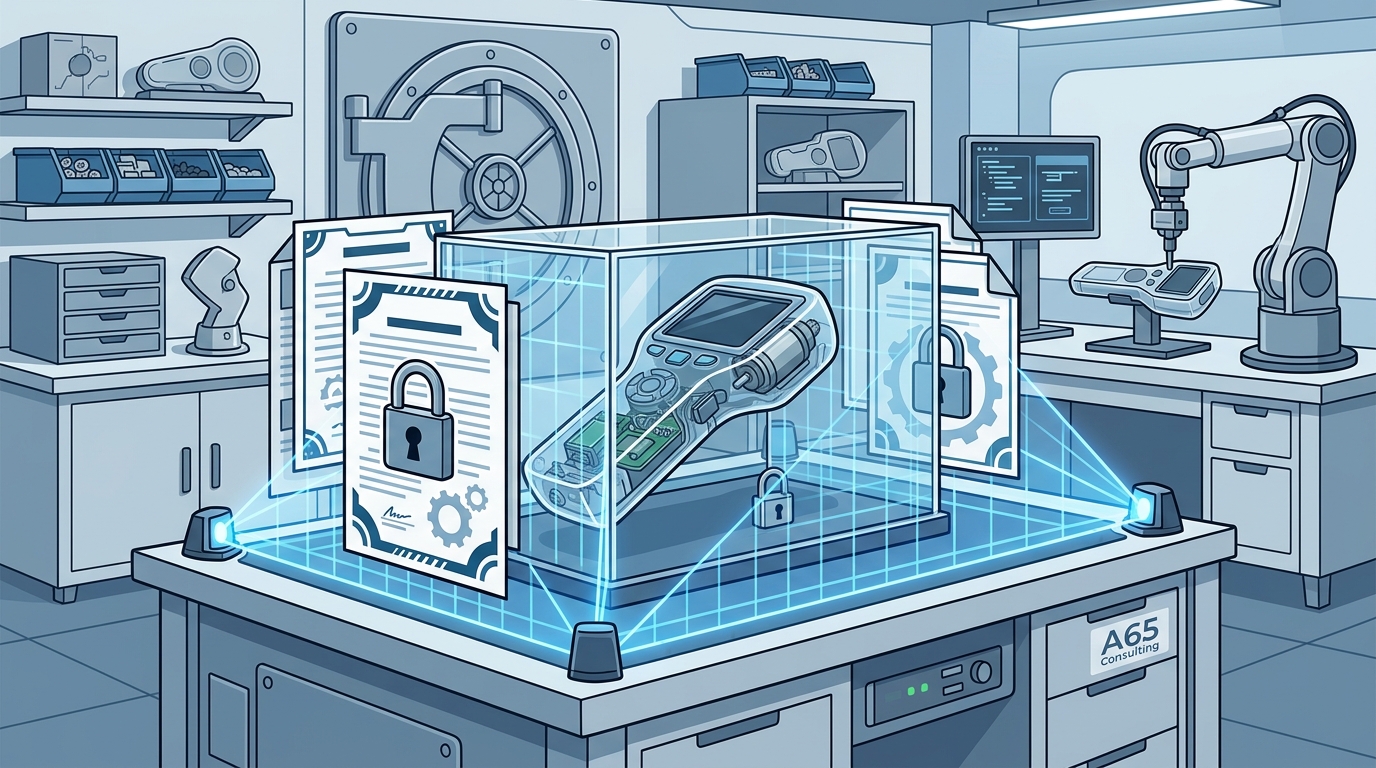
Protecting your device design and patents when working with an engineering partner requires a layered strategy combining robust legal agreements, strict operational controls, and clear ownership definitions. You must execute a comprehensive Non-Disclosure Agreement (NDA) and a detailed Master Services Agreement (MSA) before sharing any proprietary data. These documents define what constitutes confidential information and explicitly assign intellectual property rights to your company. Operational security, such as access controls and data encryption, further safeguards your assets during the development lifecycle.
The Legal Foundation: NDAs and MSAs
The first line of defense is a well-drafted Non-Disclosure Agreement (NDA). An NDA is a legal contract that prohibits one party from sharing confidential information with third parties without consent. While NDAs are standard, they are often too generic to protect complex medical device architectures. You need a tailored NDA that specifically defines the scope of your proprietary data, including CAD files, algorithms, and clinical data. This prevents ambiguity during potential disputes.
Beyond the NDA, the Master Services Agreement (MSA) dictates the business relationship. The MSA should contain a specific Intellectual Property (IP) assignment clause. This clause must state that all work product created by the engineering partner under the agreement is the sole property of the client. Without this explicit assignment, the partner may claim ownership of the designs they created, leading to costly litigation. A65 Consulting emphasizes the importance of these legal frameworks to ensure that clients retain full control over their innovations.
Consider the case of a startup developing a novel surgical robot. If their MSA lacks a clear IP assignment clause, the engineering firm could theoretically license the same robotic arm design to a competitor. By defining ownership upfront, the startup ensures that every line of code and every mechanical drawing remains their exclusive asset.
Operational Security and Access Controls
Legal documents are only as strong as the operational practices that enforce them. You must implement strict access controls to limit who can view your proprietary data. This involves creating separate user accounts for each engineer and restricting access to specific project files. Only engineers directly assigned to your project should have credentials to open your CAD models or view your test protocols. This principle of least privilege minimizes the risk of accidental leaks or intentional misuse.
Data encryption is another critical operational control. All proprietary files should be encrypted both at rest and in transit. When engineers access your data remotely, they should use secure virtual private networks (VPNs) and multi-factor authentication. These technical barriers ensure that even if a device is lost or stolen, the data remains inaccessible to unauthorized users. A65 Consulting integrates these security protocols into their project management workflows to protect client data throughout the development cycle.
For example, a medical device company developing a new diagnostic algorithm should store the source code in a secure, access-controlled repository. Engineers should not be able to download the code to local machines. Instead, they should work within a secure cloud environment where the code is processed but never leaves the server. This approach significantly reduces the attack surface for data theft.
Defining Work Product and Background IP
A common source of confusion is the distinction between background IP and work product. Background IP refers to intellectual property that the engineering partner owned before the project began. Work product is the new IP created specifically for your project. Your agreement must clearly delineate these two categories. You should have the right to use the partner's background IP if it is necessary for your product, but you should not own it. Conversely, you should own all work product created for your project.
This distinction is crucial for medical devices that often rely on existing platforms or libraries. If the partner uses a proprietary simulation tool to validate your design, you need a license to use that tool in your final product. The agreement should specify the terms of this license, including whether it is perpetual and exclusive. Failing to address these nuances can result in your product being blocked from the market due to IP infringement claims.
Patent Strategy and Filing Timing
Working with an engineering partner can accelerate your patent strategy, but it requires careful timing. You should file provisional patent applications early in the development process to establish a priority date. This protects your invention while you refine the design. The engineering partner can help identify novel aspects of the design that are patentable. However, you must ensure that the partner does not disclose these innovations publicly before you file your patent application.
Public disclosure, such as publishing a paper or presenting at a conference, can invalidate your patent rights. Therefore, you must coordinate with the partner to ensure that any public communications are aligned with your patent filing strategy. A65 Consulting works closely with clients to identify patentable features and coordinate with patent attorneys to file applications at the optimal time. This collaborative approach ensures that your IP is protected from the moment the concept is formed.
For instance, if your device features a unique user interface, you should file a design patent application before showing the interface to any external parties. This ensures that your design is protected under patent law, preventing competitors from copying your aesthetic and functional elements.
Key Takeaways
- Execute a tailored NDA and MSA that explicitly assigns IP ownership to the client.
- Implement strict access controls and data encryption to protect proprietary files.
- Clearly distinguish between background IP and work product in your agreements.
- File provisional patent applications early to establish priority dates.
- Coordinate public disclosures with your patent filing strategy to avoid invalidation.
- Use secure cloud environments to prevent local data downloads.
- Regularly audit access logs to ensure compliance with security protocols.
Frequently Asked Questions
What is the difference between an NDA and an MSA?
An NDA protects confidential information, while an MSA defines the business terms, including IP ownership and payment structures.
Who owns the IP created by an engineering partner?
Ownership depends on the MSA. Typically, the client owns all work product created under the agreement, while the partner retains ownership of their background IP.
How should I handle public disclosures?
Coordinate with your patent attorney to ensure that any public disclosure occurs after filing a provisional patent application.
What is background IP?
Background IP is intellectual property that the engineering partner owned before the project began, such as proprietary tools or algorithms.
Do I need a license to use the partner's background IP?
Yes, if the background IP is necessary for your product, you should negotiate a license in the MSA.
How can I secure my data in the cloud?
Use multi-factor authentication, encryption, and access controls to secure your data in cloud environments.
Conclusion
Protecting your device design and patents requires a proactive approach that combines legal rigor with operational security. By establishing clear IP ownership in your agreements and implementing strict data controls, you can mitigate the risks associated with working with external engineering partners. A65 Consulting is committed to helping you navigate these complexities, ensuring that your innovations remain your exclusive property. To discuss how we can protect your IP during your next project, .