
Iterative Testing in Medical Device Development: A Practical 2026 View
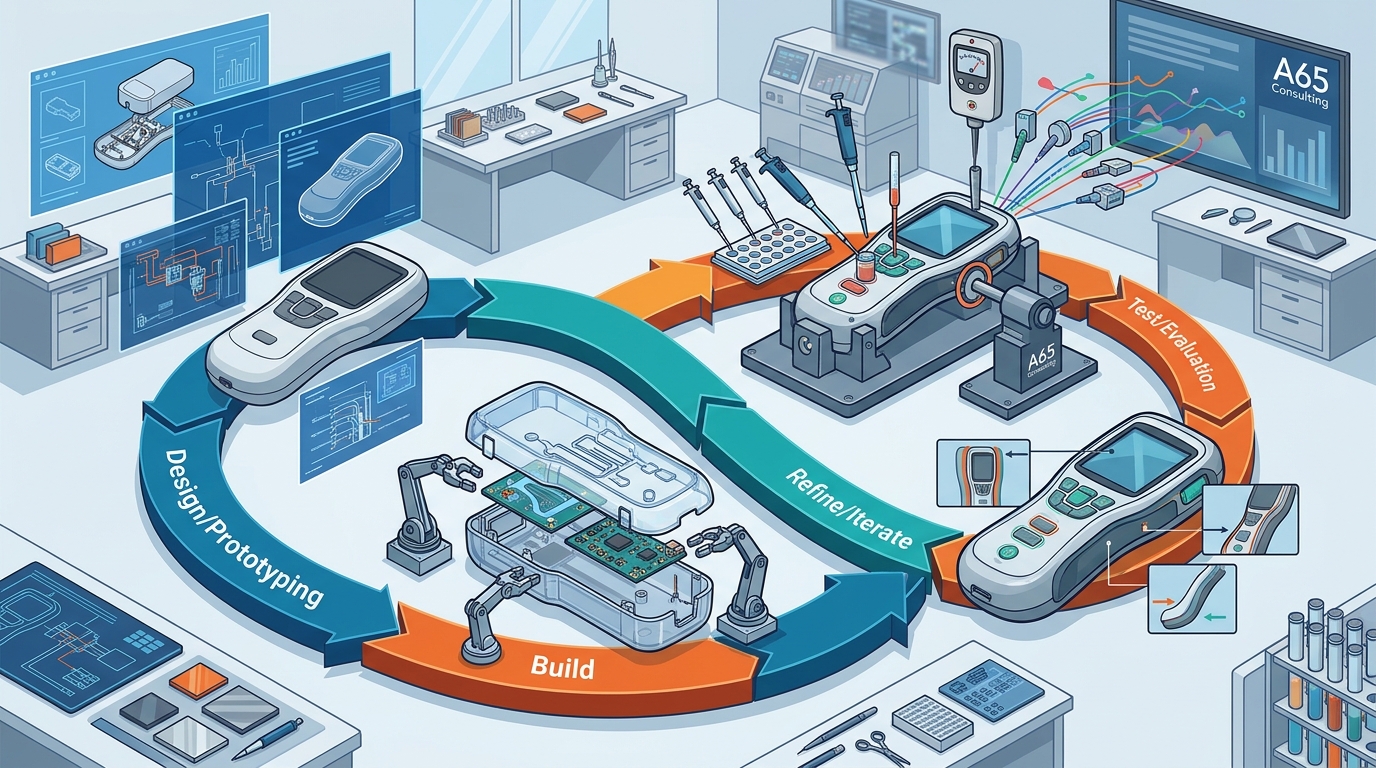
Iterative testing in medical device development is a cyclical process where engineers design, build, test, and refine a product based on empirical data. This approach ensures that the final device meets strict safety, usability, and performance standards before regulatory submission. A65 Consulting emphasizes that this cycle is not merely a quality check but a core engineering discipline that reduces risk and accelerates time-to-market.
The Core Cycle: Design, Build, and Verify
At its foundation, iterative testing is a feedback loop that connects engineering intent with physical reality. The process begins with a design concept, which is then translated into a prototype. Engineers subject this prototype to rigorous testing to gather data on performance, durability, and user interaction. The data collected during this phase directly informs the next design iteration, creating a continuous improvement cycle.
In practice, this means that a device is rarely "finished" after the first prototype. Instead, each test cycle reveals new constraints or opportunities. For example, a mechanical component might perform well in a static test but fail under dynamic load. Recognizing this discrepancy early allows the engineering team to adjust the material selection or geometry before significant tooling costs are incurred. This proactive identification of failure modes is critical for maintaining project timelines and budgets.
Human Factors and Usability Integration
Technical performance is only one dimension of device success; usability is equally vital. Human factors engineering is the application of behavioral science to the design of products and systems. In the context of iterative testing, this involves observing real users or simulated users interacting with the device prototype. These observations provide qualitative data that complements the quantitative performance metrics.
For instance, a surgical instrument might meet all mechanical specifications but be difficult for a surgeon to grip during a long procedure. By integrating human factors testing into the iterative cycle, A65 Consulting ensures that the device is not only functional but also intuitive and safe for the end user. This alignment between technical capability and user experience is essential for achieving regulatory compliance and market acceptance.
Regulatory Alignment and Risk Management
Regulatory agencies require evidence that a device is safe and effective. Iterative testing provides this evidence by documenting each design change and the rationale behind it. This documentation forms the backbone of the Design History File (DHF), which is a mandatory component of FDA submissions. By maintaining a clear audit trail of testing and design iterations, companies can demonstrate that they have systematically addressed potential risks.
Risk management is an integral part of this process. Engineers use tools like Failure Mode and Effects Analysis (FMEA) to identify potential hazards at each stage of the iterative cycle. As the design evolves, the risk profile is updated, and new mitigations are implemented. This dynamic approach to risk ensures that the final product is as safe as possible, reducing the likelihood of post-market issues.
From Prototype to Production: Scaling the Process
As the device design matures, the focus of iterative testing shifts from functional validation to manufacturability. Design for Manufacturing (DFM) is the process of designing a product in a way that facilitates efficient and cost-effective production. In the iterative cycle, this involves testing prototypes for ease of assembly, material availability, and production yield. These tests help identify potential bottlenecks before the production line is established.
For example, a complex assembly might be difficult to put together by hand, leading to high labor costs and potential errors. By iterating on the design to simplify the assembly process, engineers can reduce production costs and improve quality. This transition from development to production is a critical phase where iterative testing ensures that the device can be manufactured consistently and reliably.
Key Takeaways
- Iterative testing is a continuous loop of design, build, and verify that refines the product based on data.
- Human factors testing is essential for ensuring that the device is usable and safe for the end user.
- Regulatory compliance is achieved through detailed documentation of each design iteration and risk mitigation.
- Design for Manufacturing (DFM) testing ensures that the device can be produced efficiently and cost-effectively.
- Early identification of failure modes through iterative testing reduces the risk of costly late-stage changes.
- A65 Consulting leverages this process to help clients turn concepts into viable, market-ready products.
Frequently Asked Questions
How many iterations are typically required in medical device development?
The number of iterations varies depending on the complexity of the device and the initial quality of the design. Simple devices may require only a few iterations, while complex systems may undergo dozens. The goal is to reach a design that meets all requirements with minimal risk, rather than to hit a specific number of cycles.
What is the difference between formative and summative testing?
Formative testing is conducted during the design process to improve the product, while summative testing is performed at the end of the process to verify that the product meets its requirements. Iterative testing is primarily formative, as it focuses on refining the design based on feedback.
How does iterative testing impact the cost of development?
While iterative testing requires time and resources, it often reduces overall development costs by identifying and resolving issues early. Late-stage changes are significantly more expensive than early-stage adjustments, so the investment in iterative testing pays off by preventing costly redesigns.
Can iterative testing be done with virtual prototypes?
Yes, virtual prototypes and simulations can be used in the early stages of iterative testing to evaluate design concepts. However, physical prototypes are necessary for final validation, especially for aspects like human factors and material behavior that are difficult to simulate accurately.
What role does A65 Consulting play in iterative testing?
A65 Consulting provides expert engineering support throughout the iterative testing process. Our team helps clients define test protocols, build prototypes, analyze data, and refine designs to ensure that the final product meets all safety, performance, and usability requirements.
Conclusion
Iterative testing is the backbone of successful medical device development. By continuously refining the design based on empirical data, engineers can create products that are safe, effective, and user-friendly. A65 Consulting brings decades of experience in this process, helping clients navigate the complexities of iterative testing to bring their devices to market with confidence. To discuss how iterative testing can support your project, contact our team. Learn more: Contact A65 Consulting Book.