
Medical device product development is a structured process that transforms a clinical concept into a market-ready, regulatory-compliant product. This lifecycle ensures that safety, efficacy, and manufacturability are addressed at every step before launch. A65 Consulting guides engineering teams through these critical phases to mitigate risk and accelerate time to market.
1. Conceptualization and Feasibility
Validate the core clinical need and technical viability before committing resources.
This initial phase focuses on defining the problem and exploring potential solutions. Teams conduct market research and preliminary technical assessments to determine if the device can be built within budget and regulatory constraints. Feasibility studies help stakeholders decide whether to proceed to detailed design or pivot the concept.
2. Requirements Definition
Translate user needs into measurable engineering specifications.
Requirements definition is the process of capturing detailed functional, performance, and safety criteria for the device. This stage involves gathering Voice of Customer (VOC) data and translating it into a formal requirements document. Clear requirements serve as the baseline for all subsequent design, verification, and validation activities.
3. System Architecture and Design
Establish the high-level structure and component interactions of the device.
System engineering creates the blueprint for how the device will function as a whole. Engineers define the architecture, selecting key components and defining interfaces between mechanical, electrical, and software subsystems. This stage often includes hazard analysis and FMEA to identify and mitigate potential risks early in the design process.
4. Detailed Design and Prototyping
Develop detailed CAD models and build functional prototypes for testing.
Detailed design refines the system architecture into specific part geometries and circuit layouts. Teams create CAD models and generate prototypes to test form, fit, and function. Iterative prototyping allows engineers to validate design assumptions and make necessary adjustments before committing to production tooling.
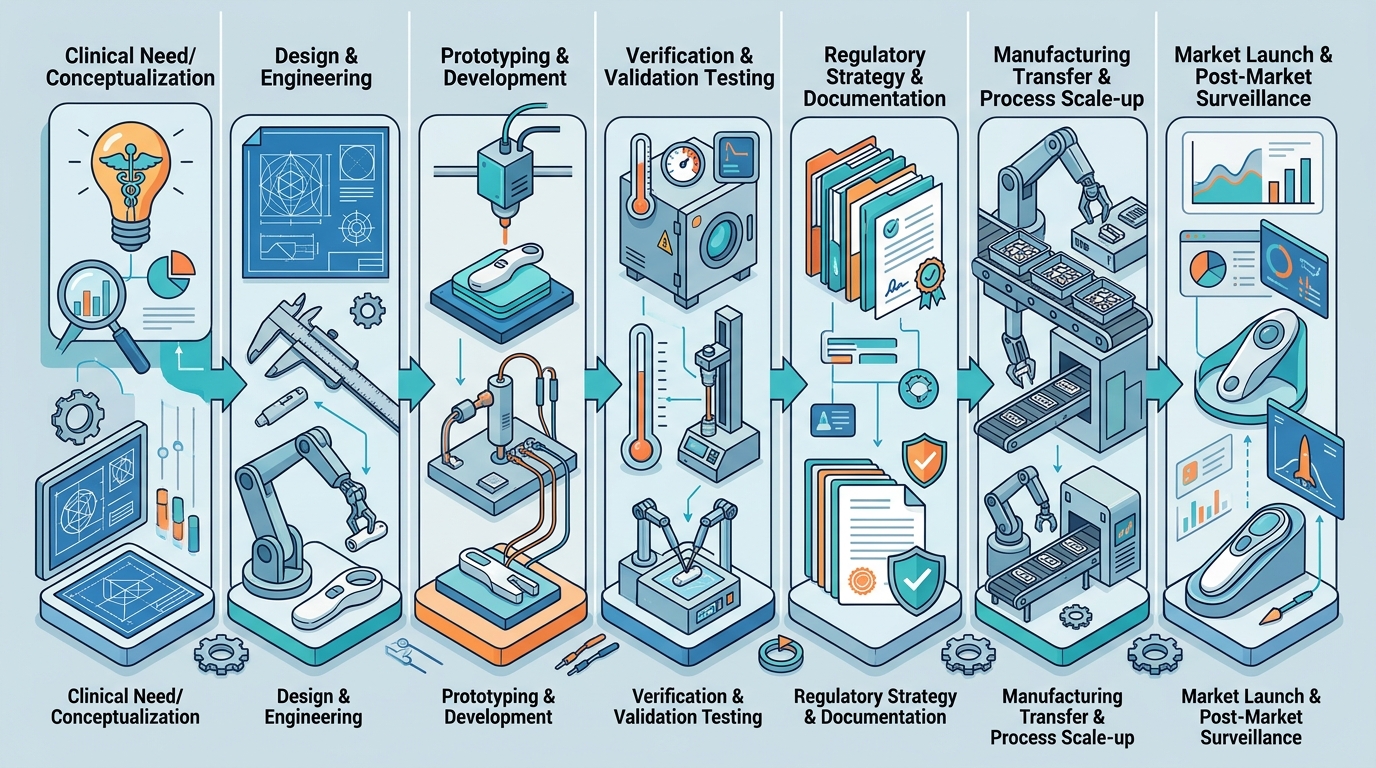
5. Verification and Validation (V&V)
Prove that the design meets requirements and is safe for its intended use.
Verification confirms that the device is built correctly according to specifications, while validation ensures it meets user needs and is safe. This stage involves rigorous testing protocols, including bench tests, biocompatibility assessments, and clinical evaluations. Successful V&V is critical for regulatory submission and user confidence.
6. Regulatory Submission and Approval
Prepare and submit documentation to obtain market clearance.
Regulatory submission is the process of compiling all technical, clinical, and quality data required by agencies like the FDA. For many devices, this involves a 510(k) premarket notification or a De Novo classification request. Navigating this stage requires meticulous documentation and a deep understanding of regulatory guidelines to avoid delays.
7. Manufacturing Transfer and Launch
Transition from prototype production to scalable, quality-controlled manufacturing.
Manufacturing transfer involves designing production processes, tooling, and quality control systems to ensure consistent output. Teams implement Design for Manufacturing (DFM) principles to optimize cost and efficiency. The final step is the commercial launch, where the device is distributed to the market and post-market surveillance begins.
Choosing the Right Approach
Selecting the appropriate development strategy depends on the device's complexity and risk profile. High-risk devices require more rigorous V&V and regulatory preparation, while lower-risk devices may benefit from streamlined processes. A65 Consulting helps teams tailor their approach to balance speed with compliance.
Frequently Asked Questions
How long does medical device product development take?
The timeline varies significantly based on device complexity and regulatory pathway. Simple devices may take 12 to 18 months, while complex systems can require 3 to 5 years. Early feasibility and clear requirements help reduce overall development time.
What is the difference between verification and validation?
Verification asks if the product was built correctly according to specifications, while validation asks if the right product was built for the user. Verification is technical and internal, whereas validation is user-focused and often involves clinical testing.
When should regulatory strategy be considered?
Regulatory strategy should be defined during the conceptualization phase. Early engagement with regulatory requirements ensures that design decisions align with submission needs, preventing costly redesigns later in the process.
Why is prototyping important in medical device development?
Prototyping allows teams to test design assumptions and identify issues before committing to production tooling. It reduces risk by providing physical evidence of performance and usability, which is essential for both engineering confidence and regulatory approval.
How does A65 Consulting support the development lifecycle?
A65 Consulting provides end-to-end engineering services, from concept to manufacturing transfer. Our team integrates with client teams to manage technical complexity, ensure regulatory compliance, and deliver viable products on schedule.
Next Steps
Ready to advance your medical device from concept to market? To plan your visit, contact our team to discuss your project and explore how our engineering expertise can support your development goals.