
Engineering a viable medical device from concept to launch is a capital-intensive endeavor that requires precise financial planning. According to industry benchmarks, the average cost to bring a Class II medical device to market typically ranges from $500,000 to over $2 million, depending heavily on regulatory complexity and manufacturing requirements. This wide variance exists because turnkey development is not a fixed-price product but a dynamic service model that scales with your specific technical challenges. Understanding the underlying cost drivers is essential for securing funding and maintaining budget discipline throughout the product lifecycle. (About A65 Consulting)
Understanding the Turnkey Engineering Model
A turnkey medical device development partner assumes full responsibility for the project, delivering a finished, compliant product ready for manufacturing. This model contrasts sharply with hiring in-house staff, where you must manage recruitment, overhead, and fragmented vendor relationships. Turnkey solutions integrate product design, regulatory strategy, and manufacturing transfer under one roof. This approach reduces the administrative burden on your leadership team while ensuring technical continuity.
The term turnkey engineering is defined as a service model where the provider manages all aspects of development, from initial concept validation to final production readiness. By consolidating these services, companies can accelerate time-to-market while mitigating the risks associated with siloed engineering efforts. For startups and established firms alike, this model offers a predictable pathway to commercialization.
Key Cost Drivers in Medical Device Development
Several critical factors influence the final price tag of your development project. The complexity of the device architecture is the primary determinant. A simple mechanical device costs significantly less to engineer than a complex electro-mechanical system requiring software validation and wireless connectivity.
Regulatory Class and Compliance
The regulatory pathway dictates the depth of documentation and testing required. Class I devices generally face lower barriers to entry, while Class III devices demand rigorous clinical data and extensive pre-market approval processes. According to the U.S. Food and Drug Administration, the cost of compliance can increase exponentially as device risk classification rises. Teams must budget for extensive design controls, risk management files, and usability testing to satisfy regulatory bodies.
Material and Manufacturing Complexity
Design for Manufacturing (DFM) plays a pivotal role in cost control. Early engagement with manufacturing experts ensures that designs are optimized for production efficiency. If a design requires custom molds, rare materials, or complex assembly processes, costs will escalate. A65 Consulting emphasizes that design for manufacturing is a quality exercise, not just a cost exercise, ensuring that the final product meets performance standards without unnecessary expense.
Cost Breakdown by Development Phase
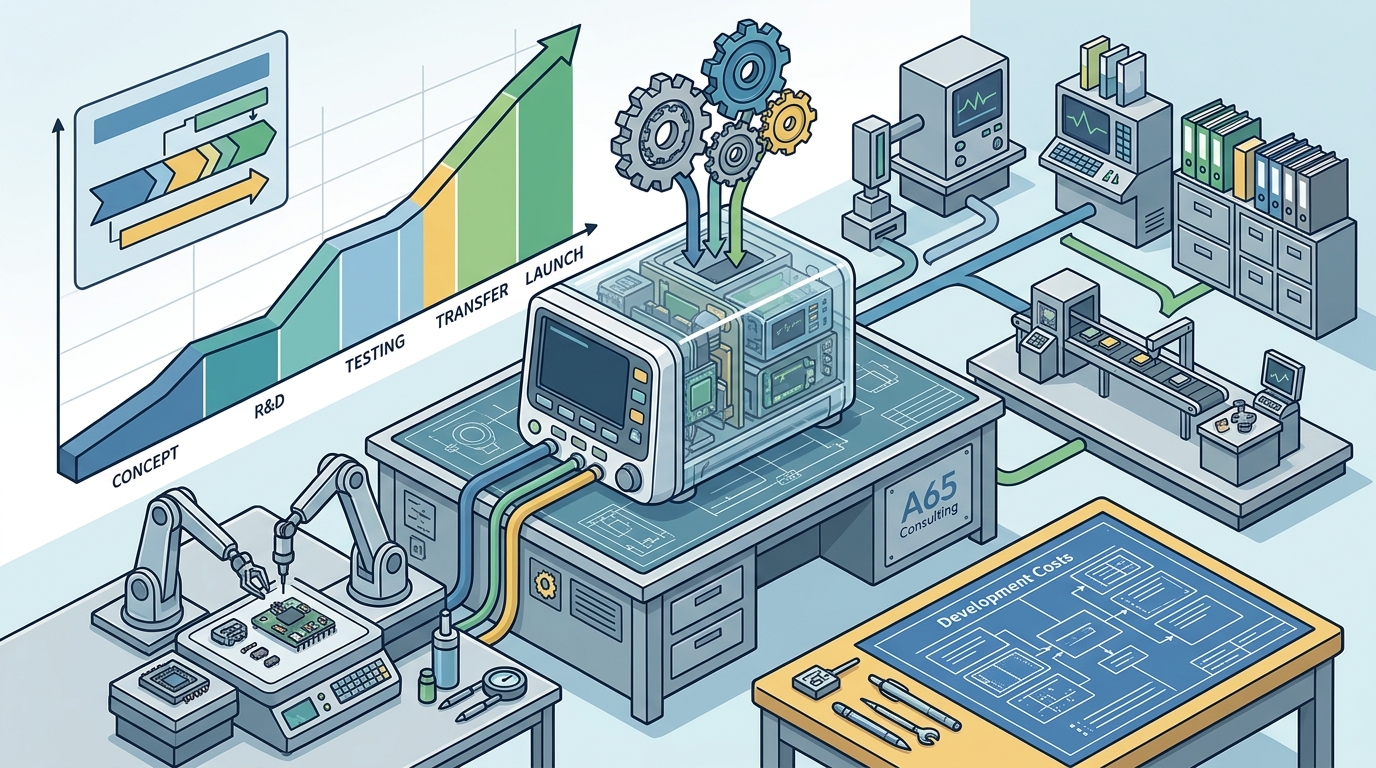
Understanding where your money goes requires a phase-by-phase analysis. Development is rarely linear, but budgeting typically follows these stages:
Concept and Feasibility
This initial phase involves market research, technical feasibility studies, and preliminary design concepts. Costs here are relatively low but critical for de-risking the project. Teams often spend $50,000 to $150,000 to validate the core idea before committing to full-scale development.
Detailed Design and Prototyping
The largest portion of engineering hours is usually allocated here. This includes CAD modeling, circuit board design, firmware development, and the creation of functional prototypes. Iterative testing and refinement are common, which can extend timelines and budgets. High-fidelity prototypes that mimic the final production part are essential for user testing and regulatory submissions.
Verification and Validation
Verification is a system, not a phase, according to modern engineering standards. This stage involves rigorous testing to ensure the device meets all specified requirements. Validation confirms that the device performs as intended in real-world clinical scenarios. Costs include lab equipment, third-party testing fees, and engineering labor for test planning and execution.
Regulatory Submission and Manufacturing Transfer
Preparing the technical file for regulatory review and transferring the design to a contract manufacturer are the final major cost centers. This includes drafting 510(k) submissions, ISO 13485 compliance documentation, and production validation protocols.
Pricing Structures: Retainer vs. Fixed Fee
Engineering firms typically offer two primary pricing models. Understanding the difference is crucial for financial planning.
| Pricing Model | Description | Best For | Pros | Cons |
|---|---|---|---|---|
| Monthly Retainer | Pay for dedicated engineering hours and expertise on a recurring basis. | Projects with evolving requirements or long timelines. | Flexibility, continuous support, scalable resources. | Less predictable total cost, requires active management. |
| Fixed Fee / Milestone | Agreed-upon price for specific deliverables or phases. | Well-defined scopes with clear endpoints. | Budget certainty, clear deliverables. | Inflexible to changes, potential for scope creep disputes. |
Many successful partnerships utilize a hybrid approach. A65 Consulting typically charges on a monthly retainer basis while working toward mutually agreed upon project milestones. This structure allows for the agility needed in complex engineering while maintaining accountability through milestone reviews.
Strategies to Optimize Your Development Budget
Controlling costs does not mean compromising on quality. Strategic planning can significantly reduce financial risk.
Early Regulatory Engagement
Integrating regulatory strategy from day one prevents costly redesigns later. Understanding the classification and required testing early allows engineers to design with compliance in mind. This proactive approach aligns with the rigorous program management standards necessary for successful product launches.
Design for Manufacturing (DFM)
Involve manufacturing experts during the design phase. Identifying potential production issues early avoids expensive tooling changes later. This practice ensures that the device can be produced at scale with high yield and low defect rates.
Leverage External Expertise
Using a turnkey partner allows you to access specialized skills without the overhead of full-time hires. This is particularly valuable for short-term needs like regulatory submission preparation or specialized testing. It provides a scalable resource model that adapts to your project's fluctuating demands.
Key Takeaways
- Turnkey development costs typically range from $500,000 to over $2 million for Class II devices.
- Regulatory complexity is the single largest variable affecting total project cost.
- Monthly retainer models offer flexibility, while fixed fees provide budget certainty.
- Early Design for Manufacturing (DFM) integration reduces long-term production costs.
- A65 Consulting has helped clients develop products contributing to more than $300M of projected new product revenue.
- Verification must be treated as a continuous system, not a final testing phase.
- Strategic use of external engineering partners can accelerate development timelines.
Frequently Asked Questions
How much does it cost to develop a simple medical device?
Simple Class I devices may cost between $100,000 and $300,000 to develop, depending on the level of customization and testing required. Complex electro-mechanical devices will significantly exceed this range.
What is the difference between a retainer and a fixed-fee contract?
A retainer model charges for ongoing engineering hours and provides flexibility for changing scopes. A fixed-fee contract sets a total price for defined deliverables, offering budget predictability but less flexibility.
How long does the development process take?
Typical timelines range from 12 to 24 months for Class II devices. This duration includes design, prototyping, testing, and regulatory submission preparation.
Do I need to hire in-house engineers if I use a turnkey partner?
No. A turnkey partner provides all necessary engineering expertise. However, having an internal product manager to oversee the project is highly recommended for alignment.
What are the hidden costs in medical device development?
Hidden costs often include third-party testing fees, regulatory submission fees, and unexpected design iterations due to regulatory feedback. Proper budgeting for these items is essential.
Can I start with a prototype before full development?
Yes. Many companies begin with a proof-of-concept prototype to validate the core technology before committing to full-scale production design.
How does A65 Consulting determine project costs?
Costs are determined through a detailed discovery process that evaluates technical complexity, regulatory requirements, and timeline constraints. We typically charge on a monthly retainer basis aligned with project milestones.
Start Your Development Journey
Turning your medical device concept into a viable product requires a partner who understands both the engineering challenges and the financial realities. A65 Consulting specializes in bridging the gap between complex technical requirements and successful market launch. Our team brings decades of experience in medical device innovations and product development to help you navigate this journey with confidence.
Do not let budget uncertainty stall your innovation. Schedule a discovery call with our principal consultant to discuss your specific project needs and receive a tailored cost estimate. Visit our contact page to get started, or explore our services to learn how we can support your development goals. For a deeper understanding of our approach, download our guide on engineering your next medical device.