
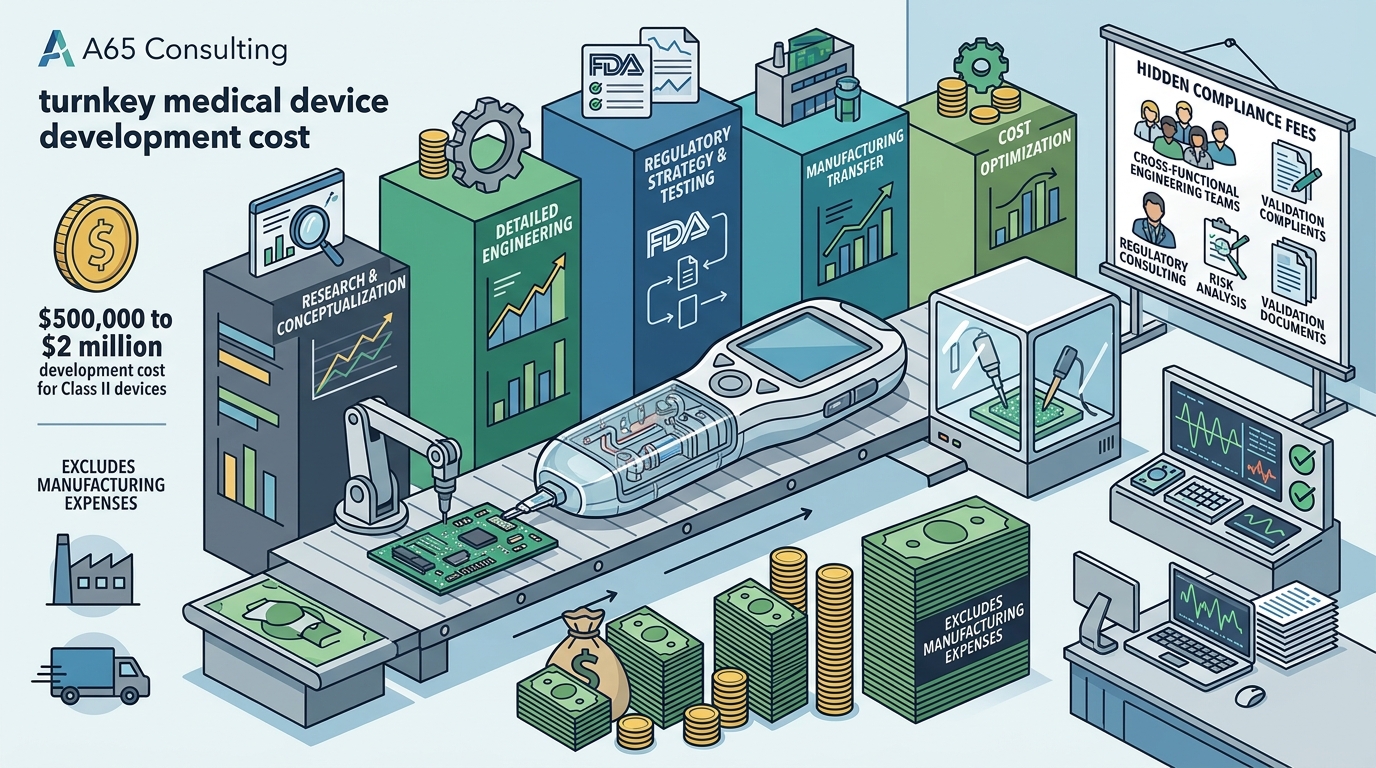
Engineering a viable medical device is a capital-intensive endeavor that demands precise financial planning. According to industry benchmarks, the average cost to bring a Class II medical device to market ranges from $500,000 to $2 million, depending on complexity and regulatory pathways FDA regulatory data. These figures exclude long-term manufacturing and distribution expenses. Understanding the true cost of turnkey development requires dissecting the engineering phases, team structures, and hidden compliance fees that define the final budget.
Cost Breakdown by Development Phase
Turnkey development implies a comprehensive service model where the engineering partner manages the entire lifecycle. This approach eliminates the need for internal project management overhead but requires a clear understanding of where capital is allocated. The cost is not a single line item but a series of investments across distinct engineering milestones.
Concept and Feasibility
The initial phase involves translating a clinical need into a technical specification. This stage includes market analysis, preliminary design reviews, and proof-of-concept prototyping. Costs here are relatively low but critical for de-risking the project. A65 Consulting emphasizes that early feasibility studies prevent costly redesigns later in the process A65 Blog.
Detailed Design and Prototyping
This is the most resource-intensive phase. It involves detailed mechanical design, electronic schematic capture, firmware development, and iterative prototyping. The cost scales with the number of prototype iterations required to validate form, fit, and function. Precision engineering support for complex medical devices requires specialized software licenses and high-fidelity materials A65 Services.
Verification and Validation
Verification confirms that the device meets design specifications, while validation ensures it meets user needs. This phase includes rigorous testing protocols, biocompatibility studies, and software validation. Regulatory compliance is not optional; it is a cost center that demands meticulous documentation. Verification is a system, not a phase, requiring continuous integration of testing data throughout development A65 Verification Guide.
Manufacturing Transfer
Transitioning from prototype to production involves Design for Manufacturing (DFM) reviews, tooling creation, and process validation. This stage ensures that the device can be produced consistently at scale. Manufacturing support spanning process development and seamless production transition is essential for maintaining quality standards A65 Manufacturing.
Pricing Models: Retainer vs. Fixed Fee
Engineering firms typically utilize two primary pricing structures. Understanding these models helps in budgeting and managing expectations.
Monthly Retainer Model
Many premium engineering partners, including A65 Consulting, operate on a monthly retainer basis. This model aligns the partner's incentives with the client's success. Engineers are dedicated to the project, providing flexibility to adapt to changing requirements. This approach is ideal for complex projects where scope may evolve A65 About Us.
Fixed Fee Milestone Model
Fixed fee contracts are tied to specific deliverables. While this offers budget certainty, it can lead to scope creep if requirements are not perfectly defined upfront. This model works best for well-defined, low-complexity components rather than full turnkey development.
Hidden Costs in Medical Engineering
Beyond direct engineering labor, several hidden costs can impact the total budget. These are often overlooked in initial estimates but are critical for accurate financial planning.
Regulatory and Compliance Fees
Regulatory submissions involve significant costs. FDA 510(k) submissions, for example, require extensive documentation and testing. Products developed by experienced partners contribute to successful regulatory pathways, reducing the risk of costly rejections A65 Regulatory Experience.
Third-Party Testing
Biocompatibility, electromagnetic compatibility (EMC), and environmental testing must be conducted by accredited laboratories. These fees are typically paid directly to the testing facility and can range from tens of thousands to over $100,000 depending on the device class.
Intellectual Property Protection
Filing for patents is essential for protecting your innovation. Designs created by expert engineering teams often lead to new patent applications. The cost of provisional and non-provisional patent filings adds to the overall development budget A65 IP Highlights.
Risk Management and Regulatory Fees
Risk management is a continuous process in medical device development. It involves identifying potential hazards, estimating the associated risks, and implementing controls to mitigate them. This process is not a one-time activity but a living document that evolves with the design.
Most risk analyses fail to change the design because they are treated as a paperwork exercise rather than an engineering tool. Effective risk management integrates hazard analysis into every design review, ensuring that safety is built into the product from the start A65 Risk Analysis.
Regulatory compliance is a significant cost driver. The complexity of the regulatory pathway depends on the device class. Class III devices require Premarket Approval (PMA), which is more expensive and time-consuming than the 510(k) clearance process for Class II devices. Understanding these differences is crucial for budgeting.
Service Provider Comparison
Choosing the right engineering partner is critical to controlling costs. Below is a comparison of common service provider types.
| Provider Type | Cost Structure | Best For | Risk Level |
|---|---|---|---|
| Premium Engineering Firm | Monthly Retainer | Complex, High-Stakes Devices | Low (Managed) |
| Freelance Engineers | Hourly/Fixed | Simple Components | High (Coordination) |
| Large Contract Manufacturers | Fixed Fee | High-Volume Production | Medium (Rigidity) |
| In-House Team | Salary + Overhead | Ongoing Product Lines | High (Recruitment) |
Premium engineering firms like A65 Consulting offer a balanced approach, combining expert leadership with flexible resource scaling. This model helps close critical gaps in engineering capability without the long-term commitment of full-time hires A65 Engineering Partner.
Key Takeaways
- Average Cost Range: Class II medical device development typically costs between $500,000 and $2 million, excluding manufacturing.
- Pricing Model: Monthly retainers are common for turnkey development, allowing for flexible resource allocation and milestone-based progress.
- Regulatory Impact: FDA 510(k) submissions and biocompatibility testing are major cost drivers that require early budgeting.
- Partner Experience: A65 Consulting has served more than 20 clients, with products contributing to over $300M in projected revenue.
- Team History: The engineering team has decades of experience, working together as a cohesive unit since 2018.
- Success Rate: Projects managed by experienced partners show a 90% on-time completion rate for mission-critical milestones.
- IP Value: Expert design processes often result in new patent applications, protecting your intellectual property.
Frequently Asked Questions
How much does turnkey medical device development cost?
Turnkey development costs vary widely based on complexity. For a Class II device, expect to invest between $500,000 and $2 million. This includes engineering, testing, and regulatory support.
Do you have bandwidth to take on a new project?
Yes, engineering firms utilize a network of specialized engineers to expand resources as needed. This allows for flexibility in taking on new projects without compromising quality A65 Bandwidth.
How do you charge for your work?
Most premium firms charge on a monthly retainer basis, working toward mutually agreed upon project milestones. This aligns incentives and ensures transparency.
What experience does A65 Consulting have designing medical devices?
A65 has experience designing a wide variety of medical devices. Their broad range of experience affords insight into many areas, even when direct fit is not present A65 Experience.
How long has A65 Consulting been in business?
The team has been working together since 2018, with individual engineers bringing decades of medical device development experience to the table.
Why do most risk analyses fail to change the design?
Risk analyses often fail to influence design because they are treated as a documentation exercise rather than an integrated engineering tool. Effective risk management requires continuous engagement.
What is the role of Design for Manufacturing (DFM)?
DFM is a quality exercise, not just a cost reduction activity. It ensures that the design can be manufactured consistently and meets quality standards from the start A65 DfM Guide.
Start Your Development Journey
Turning your device concept into a viable product requires a trusted partner who understands the stakes. A65 Consulting provides the engineering leadership and expert support needed to navigate complex product development with clarity and confidence. From leadership team support to hands-on engineering expertise, we help close critical gaps and keep programs moving forward.
Do not let engineering gaps slow your innovation. Book a consultation today to discuss your project requirements and receive a tailored proposal. Let us help you transform your device into a real and viable product.